

TL;DR Key Findings:
- Group revenue rose 6% to £1,237.2m, with subscription revenue up 9% to £1,136.7m, 92% of the total.
- Adjusted EBITDA rose 16% to £188.2m, a margin of 15.2% (FY2025: 13.9%).
- Profit before tax increased £31.7m to £47.4m (FY2025: £15.7m).
- US subscription revenue grew 82% to £61.0m on 543k subscription customers (FY2025: 284k).
- Total net leverage fell to 4.3x (FY2025: 4.9x) on earnings growth, not debt repayment.
- Asurion’s £2.1bn consideration represents 11.2 times FY2026 adjusted EBITDA, down from 13.0 times on FY2025 earnings.
Full analysis also available as a downloadable report at reports.finsur.co.uk
Britain (and Europe) is good at growing companies to a certain size. It is less good at finding out how big they might have become, because somewhere around that size an American buyer often turns up. Domestic & General was founded in 1912, listed in 1991, taken private in 2007 and has spent the nineteen years since passing between private equity houses. It now has 7.0m subscription customers across 12 markets and reported revenue of £1,237m. Asurion reports more than 230m customers worldwide but seemingly requires a defibrillator to restart its European ambitions.1 That is going to cost them £2.1bn for £188m of adjusted EBITDA, earnings worth more inside Asurion than inside private equity. Once that is true, independence is only a matter of price. Let’s have a last look…
Recap
Domestic & General (“D&G”) is the UK’s largest appliance warranty and protection business, with operations in Europe and the US and a subscription book of over 7.0m customers. They were first listed on the London Stock Exchange way back in 1991, the same year the world wide web made its debut. After a brief dalliance with HomeServe,2 private equity firm Advent took them private in 2007. Six years later Advent sold them to CVC in 2013. From 2018, D&G transitioned their main product line from discretionary service plans to insurance policies, re-capitalising the business accordingly and then focusing on moving the product portfolio from single-premium business to monthly recurring, or more fashionably/valuably, subscription premiums.
In 2019, the Abu Dhabi Investment Authority took a 30% stake in D&G which, according to an FT article at the time,3 valued the business at £1.1bn. Whilst the ownership percentages have shifted around a little since then, CVC have maintained their majority shareholding. In December last year and to some surprise, Asurion announced they were to acquire D&G for a consideration of £2.1bn with a target close date around mid-2026.4
According to the FY2026 results presentation, the acquisition processes are well-advanced and the previous timing guidance remains valid. So, this is likely to be the last full independent results release from D&G and presumably, post close, public filings will be limited to the entity filings according to the various company registry requirements. So let’s take a last look…
Performance
Group total revenue increased 6% to £1,237m (FY2025: £1,162m) with management attributing the increase to subscription growth across the UK and International businesses, partially offset by the continuing planned reduction in non-subscription revenue.
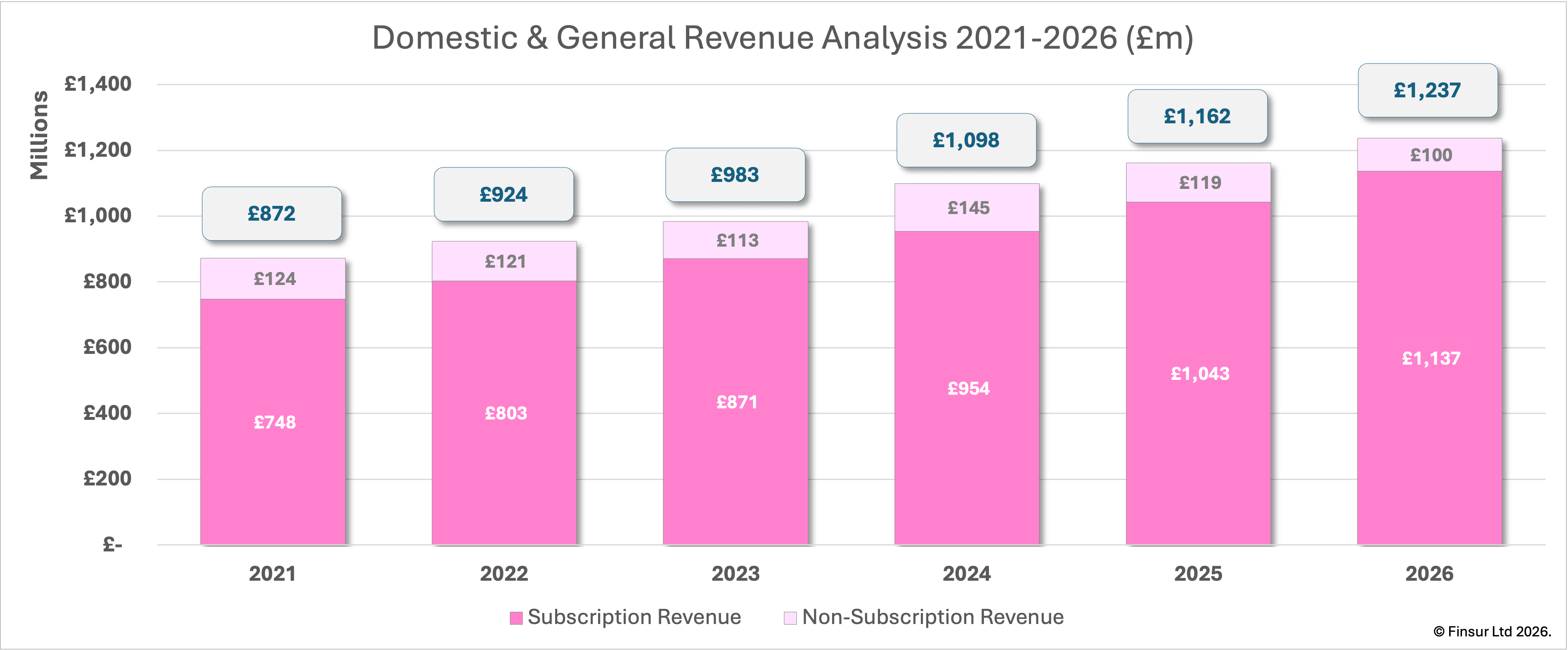
Group subscription revenue rose 9% to £1,137m (FY2025: £1,043m) with growth coming from all three territorial segments including the US growing fastest at 82%. The three percentage point gap between subscription growth of 9% and total revenue growth of 6% highlights the continuing and planned mix shift towards subscriptions: group non-subscription revenue fell 16% to £100m (FY2025: £119m) with the decline concentrated in Europe, down £15.0m, and the US, down £5.6m, partially offset by a £1.8m increase in the UK.
According to ONS data, UK retail volumes of new electrical household appliances grew every month across D&G’s FY2026 period at an average of 11%, suggesting that the underlying appliance market was expanding in unit terms.5 Against this, D&G’s total UK revenue came in up 5% at £962m (FY2025: £912m), with over 95% of sales on a subscription basis. However, UK customer numbers were flat at 4.7m, which implies the revenue increase came from pricing and a higher average number of plans per customer rather than exploiting the growth in underlying product sales directly. Still, management noted that UK revenue has now grown for more than 20 consecutive years.
The muted 2% headline increase in European & Other revenue to £192m (FY2025: £187m) obscures a 14% increase in subscription revenue to £158m offset by the planned drop in single premiums. Over the year, subscription revenue accounted for 82% of the European total (FY2025: 74%). The European & Other revenue line also carries a residual Australia and New Zealand run-off block. Total US revenue increased 35% to £84m (FY2025: £62m), with subscription revenue up 82% to £61m (FY2025: £34m) and non-subscription revenue down to £23m (FY2025: £29m).
Revenue per subscription customer across the group rose 4% to £162 (FY2025: £155), as subscription customers increased to over 7.0m (FY2025: 6.7m) and UK and European retention held at 86% (FY2025: 86%). Management attributed the increase to a higher average number of plans per customer and to pricing. That prices could rise while retention held steady points to pricing power, a customer base that mostly absorbs an increase rather than leaving, which is what makes the UK's mid-single-digit growth more durable than a one-off.
Finsur is a reader supported publication. Paying subscribers can read on for:
Why an effective tax rate approaching double the UK headline rate says more about the American business than the British one
Where net debt rose while leverage fell, and what the capital position suggests about the delay to completion
What another year of growth has done to the multiple agreed last November, and who is better off for it
Alternatively, if a subscription is not feasible, please find a link to a downloadable version here.