

Sorry for the slight delay. I’ve just finished putting down a concrete base for a new shed before the overnight temperatures get too low. It’s not huge, but just large enough to provoke my lower back muscles into making an awkward appearance at the end of each day. On top of that, I’m still trying to fit in a few decent training runs before my last 50 miler of the year in a few weeks. Still, being a bit of a mycophile, October and November are some of my favourite months in which to run, so excuses over, besides the Yellowfoot Dapperlings and Magpie Inkcaps, here are a few of the items that caught my attention last month…
Market
Whilst the iPhone Duo subreddit has been on fire with cracked screens and buckled hinges, so far Apple have suggested the teething issues, that you rightly shouldn’t expect with a £1,999 plus phone, have been limited to a “small number” of devices.1 When I published the Apple Duo Repair Pricing article a few weeks ago, third party insurance pricing hadn’t been released, and I think it’s fair to say that not all providers are completely caught up: Three looks like the clearest case with a £1,999 foldable policy priced within their existing tiers and O2 has not yet published an excess for their new £15 policy premium tier.
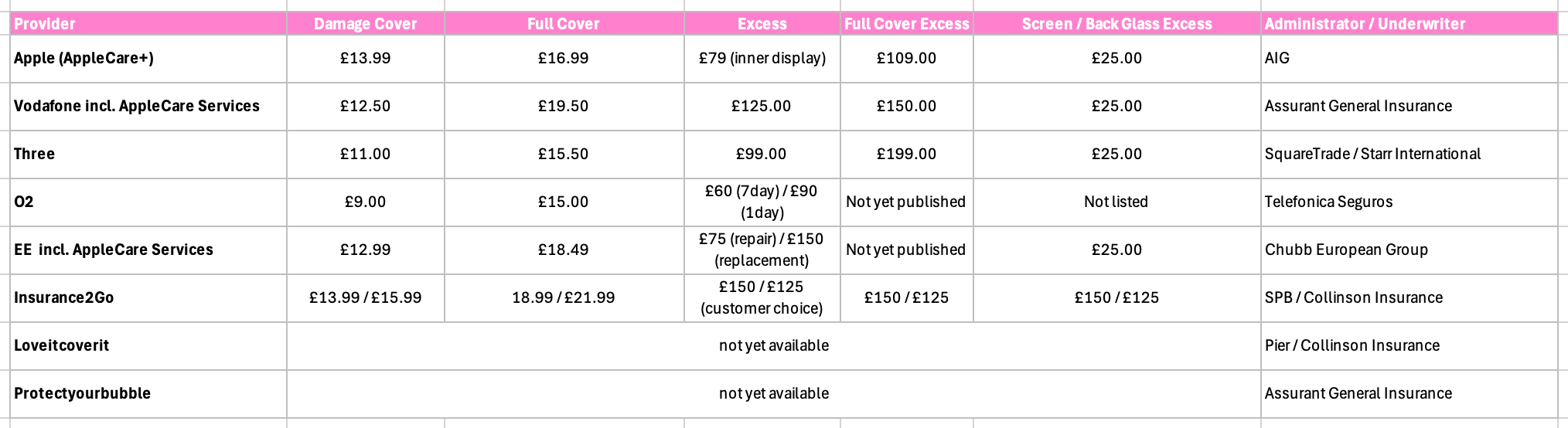
But at this stage, on policy premium alone, Apple isn’t the cheapest with the £16.99 AppleCare+ with Loss & Theft sitting in between Vodafone’s £19.50 policy and the £15.00 offer from O2. On damage only, O2 is the cheapest at £9.00. Apple is harder to beat when it comes to the policy excess though, with £79 for an inner display well under everyone else’s ranging from £99 to £150, the one exception being EE’s £75 for repair. I can’t help but think that if you’re pricing below Apple, you’re either hoping people are heading elsewhere for their Duo insurance, or the insurance operations team are content with their repair and spare parts arrangements.
Sticking with the Duo for just a moment longer, I recognise the device has been on sale for just over a week, so there’s little to take from resale prices other than a glance and a gawp and a “nobody is actually selling their shiny new gadget at these prices are they?”.
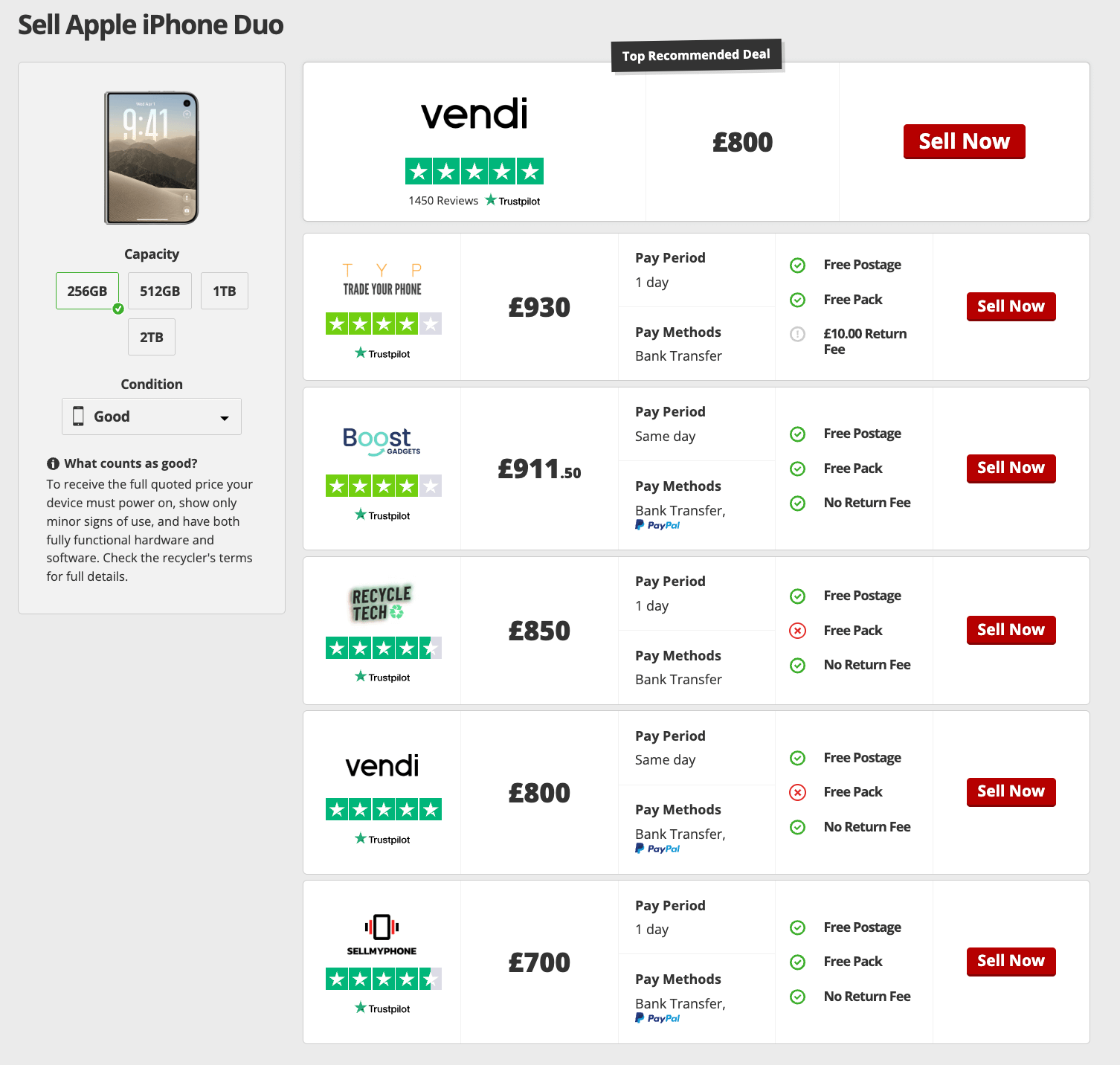
For the record, the best offer for a 256GB Duo in Good condition is £930, already £69 short of Apple’s £999 inner display repair. For the trade at least, depending on parts availability and pricing, a cracked Duo is probably close to a write-off inside its first week.
Outside of the relentless lows for new device shipments,2 and the mixed reports on the iPhone 18 Pro,3 FDM CCS Insight are pointing to improvements in the secondary market. According to their latest research,4 trade-in and upgrade programmes are driving higher-quality, with Grade A devices rising from 19% to 22% in 2Q26, while Grade B devices increased by nine percentage points to 33%. Their suggestion is that consumers are increasingly trading in devices when upgrading rather than keeping them as backups. There was no geographic scope detailed in the snippet, but nonetheless, some positive news for the sector.
That said, there’s still plenty to go after, even when accounting for the slightly stale data released by Eurostat last month,5 which highlights the stubbornly wide gap between WEEE collected per person at 12.3kg, and the 32.4kg of new electrical and electronic equipment (per person) put on the market in 2024. Bulgaria (18.9kg), Czechia (17.8kg) and France (17.7kg) collected the most e-waste with Cyprus (4.7kg), Portugal (6.0kg) and Malta (6.4kg) recording the lowest collections. According to 2024 Environment Agency data for the UK, we wouldn’t compare well with approximately 7.2kg WEEE collected per capita. Even the slight improvement to 7.3kg in 2025 would only put us 17th out of 22 markets covered. Looking at the data another way, the EU collected back around 38% of the weight of new equipment it placed on the market; on a comparable basis the UK managed about 27%, ahead of only Spain and Portugal.
By way of example, I picked up the headline that DT were measuring their circularity for the first time.6 On what basis that’s the case I am not sure, but it prompted me to take a look at their published ESG key indicators. I first looked at these a few years ago on a client project and then again when I was researching the GSMA Pace setting targets last year. Perhaps DT are having a bit of a circularity reset, because the FY2023 and FY2024 “Return Ratio Mobile” KPI data has disappeared and we’re left only to ponder the 11% figure for FY2025, excluding TMUS. I’d previously recorded a 9.4% take-back rate for DT Germany and a 6.2% take-back rate for DT Europe in FY2023, averaging 7.8% outside the US. Assuming device sales have remained flat since, 11% would translate to approximately 790k units. Still someway off the GSMA 20% target, although adding TMUS back into the calculation would see them well clear. As I said, plenty to go after.
I picked this up too late for the last Round Up, but worth recording: the European Public Prosecutor’s Office announced on 29th September that its Troja investigation had uncovered a criminal organisation suspected of selling more than one million used phones as new since 2018.7 Allegedly, the devices were assembled from used components in Hong Kong and the UAE, cleaned and boxed as new in the Netherlands, then sold across the EU through online marketplaces from German warehouses. Shell companies in five countries applied the margin scheme to their sales, so the phones were secondhand for VAT and new for the customer. EPPO estimates the damage to customers at €300m and the lost VAT at €30m, at least €25m of it in Germany.8 Seven arrests, including the two alleged leaders, preceded searches at more than 160 locations across 19 countries. No platforms or brands were named officially, which didn’t stop reporting by WDR, NDR and Süddeutsche Zeitung pointing to Samsung devices mainly sold through Amazon.9 There, buyers checking device IDs with Samsung were told their phones were not new. Ouch.
Companies
SquareTrade FY2025
Another one that fell into September after I had already scheduled the Round Up was the FY2025 filing for SquareTrade Limited, the UK entity of Allstate Protection Plans, that rolled in on the last day of the month. The entity recorded £70.0m in revenue, down 8.3% (FY2024: £76.3m). The intercompany recharge for supporting the wider European operation held steady at £31.7m (FY2024: £31.2m), meaning the decline came from insurance policy revenues, down 15.2% to £38.2m (FY2024: £45.1m). Helpfully, management continue to split revenue by destination which shows the UK revenue, essentially from the Three mobile phone insurance programme, broadly stable at £23.4m (FY2024: £23.8m), implying legacy European business still written through the UK entity fell 30% to £14.8m (FY2024: £21.3m). Whether the revenue migrated to the Malta entity, I will have to wait and see. The reported operating loss of £2.0m (FY2024: £1.0m profit) included a £3.0m exceptional charge relating to a long-running and still unresolved Danish VAT dispute over claim handling services. Excluding that, underlying operating profit was £1.1m, slightly ahead of the prior year, with lower distribution costs offset by a 12% rise in average headcount and the associated costs. The parent also subscribed for £18.4m in new share capital, lifting net assets to £35.7m. Much of that, however, appears to have gone towards reducing amounts owed to group companies, down from £12.0m to £4.9m. Cash closed up at £2.2m (FY2024: £1.0m). The more interesting, long term development is the new insurance entity domiciled in Belgium, which came with €50m of capital. I’ll cover that in more detail once the Malta entity FY2025 accounts are available.
Assurant (UK) FY2025
Assurant’s non-insurance entities, now consolidated through Assurant Direct Limited, posted their FY2025 filings in October. Consolidated revenue was down 1.5% to £223.3m (FY2024: £226.7m), which management attributed to lower volumes. Sale of goods, essentially the revenues from Assurant Device Care (ADC), fell 9.5% to £85.8m (FY2024: £94.9m) and rendering of services, essentially the revenues from the Lifestyle Services Group (LSG) entity, rose 3.8% to £131.5m (FY2024: £126.7m). ADC’s goods sold to group companies fell 14%, so the decline is mainly lower device supply into group claims fulfilment rather than a reduction in external trade. Gross margin rose to 48.4% (FY2024: 46.3%) as the lower margin goods fell away. Administrative expenses, however, rose £3.2m to £107.9m, which management stated was “in line with inflation”, absorbing all the gain and leaving operating profit at £0.2m (FY2024: £0.3m). For those keeping an eye on iSmash, revenue grew 7% to £14.5m, but the operating loss widened to £4.4m (FY2024: £3.3m). The going concern note states that losses will continue and more group funding will be needed. Excluding iSmash, operating profit was about £4.6m (FY2024: about £3.6m). Profit before tax landed at £1.8m (FY2024: £5.4m), but FY2024 included a £3.4m pre-consolidation dividend, so the like-for-like fall is closer to 10%. Cash rose to £42.3m (FY2024: £31.5m) and although reserves were too thin for another dividend (FY2024: £33.6m), LSG prepaid £31.2m of future service charges to its US parent, funded by a 3.69% note due 2028; profit now moves upstream through fees and interest, and the cash follows in 2028. With the barrel scraped, the answer appears to be some genuinely clever accounting. Kudos.
Raylo Funding Update
Raylo restated its NatWest senior and OpCo facilities for the second time in ten months, with fresh security over Raylo Group and its receivables SPV, Honey Bear Finance. The facilities pay for the devices behind new subscriptions, allowing Raylo to keep growing. Both lenders chose to restate rather than run off, and the security package is essentially unchanged from December, which is about as clear a vote of confidence as a charge register can give. Any inference beyond that is unwise: as usual, the charges tell us nothing about size, headroom, maturity or pricing. Both Raylo Holdings and Raylo Group have extended their accounting periods to 31 December 2026, bringing the refinancing, June’s new warrant instrument and the share authorities inside the next set of accounts. The catch is that those accounts aren’t due until September 2027. Still, perfect timing for the launch of Raylo’s small businesses rental offer on HP.com, “powered by Raylo”, with laptops from £14.79 a month and printers from £4.99.10 The small print reveals that HP acts as a credit intermediary, and the hire agreement is with Raylo Group, which owns the devices and carries the credit and residual risk. “Subscription infrastructure” therefore still means Raylo’s balance sheet, funded by those same facilities. HP joins Apple, Google and LG on the client list; whether it moves the dial will only become clear in those same accounts.
Lancaster Group Holdings (Mazuma & ICT Reverse) FY2026
Having spent a few minutes sitting down with the inimitable Craig Smith at Retech Days Berlin last May, I’ve been waiting keenly for their next set of results. They didn’t disappoint. Management called it a record year with PBT of £7.7m, up 46.8% (FY2025: £5.2m restated). The strategic report credits employees, customer loyalty and “management’s overarching strategic vision”. Revenue was up 20.5% to £57.8m (FY2025: £48.0m restated). Trade sales were the driver, up 27.4% to £43.6m (FY2025: £34.2m). E-channel and online sales rose 3.5% to £14.3m (FY2025: £13.8m). Of the Group total, Mazuma Mobile revenue was up 17.8% to £46.0m (FY2025: £39.1m), about 80% of the Group, in what management described as “another outstanding year”, crediting investment in technology with “significantly boosting customer acquisition and retention”. Trade sales at Mazuma rose 25.3% to £32.5m and online sales 2.9% to £13.5m. ICT Reverse files small-company accounts with no P&L, but Group revenue outside of Mazuma was £11.8m, up 33% (FY2025: £8.9m). That figure includes any parent items and intragroup eliminations, so it’s directional for ICT, not reported. Group gross margin rose to 28.9% (FY2025: 27.7%), with the improvement seemingly coming from outside Mazuma, where gross margin slipped a bit to 22.6% (FY2025: 23.4%). With an eye on the future, management flagged consumer trade-in as increasingly competitive in a growing market and warned against demand gaps “being fulfilled by product from other territories”. Interesting.
Webuyanyphone FY2025
An increasingly competitive market is perhaps the best explanation for WBAP’s FY2025 results although management cited “challenging trading market conditions and a contraction in demand within the sector”. I’ll buy the first bit; Lancaster Group management might not agree with the second bit. Revenue was down 1.4% to £31.0m (FY2024: £31.5m). Gross margin was down about 260bp to 22.6% (FY2024: 25.2%), taking gross profit down 11.6% to £7.02m (FY2024: £7.94m). As you’d expect with revenue flat, cost of sales provided the squeeze, up 2.0% to £24.0m (FY2024: £23.5m). All that resulted in a loss before tax of £646k (FY2024: profit £1.70m). Management stated the loss reflects the “challenging trading environment and continued investment in infrastructure and resources to support future growth” which must have gone through overheads as admin expenses rose 22.5% to £7.57m (FY2024: £6.18m) while capex fell to £68k (FY2024: £173k).
Investments
Asurion completed its acquisition of Domestic & General on 8 October.11 That was later than both the mid-2026 target set at announcement and the September quarter end D&G was still guiding to in August, possibly reflecting the change in control discussions with the PRA and BaFin I flagged in July.12 D&G’s Q1 FY27 update shows it handed over in good shape, with adjusted EBITDA up 12% to £54.9m, subscription customers at 7.1m and retention steady at 86%.13 Over the last twelve months adjusted EBITDA reached £194.2m, which takes the reported £2.1bn consideration to roughly 10.8 times, down from the 13 times I calculated on announcement14 and 11.2 times on FY2026 earnings. The US is still doing the heavy lifting, with subscription revenue up 70% on more than 608,000 customers, and the regulated group’s solvency ratio rose to 211%. The £350m notes and €545m term loan remain in place under the change of control terms; what Asurion chooses to do with them now that it owns the business is the next thing to watch.
Back in June, I noted bolttech CEO Rob Schimek’s wish for strategic investors “who won’t shift their priorities.”15 Which in start-up terms probably means growth to profit. That wish went one stage further with a strategic deal that kept it in the family, as FWD agreed to buy 25% of Bolttech Insurance (Hong Kong) from bolttech’s holding subsidiary for a base consideration of US$20.72m (HK$161.62m).16 FWD is no stranger to the business. The insurance carrier traded as FWD General Insurance until bolttech acquired it in late 2020, and both companies sit within Richard Li’s Pacific Century Group.17 The price values the insurer at around HK$646m, about 1.85x its June net assets of HK$349m. It can only be adjusted downwards at completion, depending on net assets, solvency and combined ratio, which seems prudent after a HK$31m loss in 2025 and an unaudited HK$21m profit in the first half of 2026. In effect, a quarter of the business has moved from one Li pocket to another. Very strategic.
Apple Trade-In partner PCS Wireless has taken a 10.36% stake in ReNet Japan Group, the Tokyo-listed reuse and recycling business with collection partnerships across more than 770 municipalities.18 PCS subscribed ¥1.5bn for 2.1m new shares alongside JX Metals Circular Solutions and SG Holdings, and holds warrants over a further 2.6m shares at ¥1,077 and ¥1,436, well above the ¥718 issue price; the headline $34m figure only materialises if those are exercised. PCS will feed used smartphones and PCs from its global sourcing network into ReNet’s refurbishment and domestic sales, with devices unfit for reuse routed to JX Metals for material recovery.
Peace,
sb.