

Right, after taking a decent amount of time away from the laptop, walking plenty of Cornish beaches and catching a few waves on the bodyboard, it’s time to get back at it, although with a few changes in the pipeline. Until then, here are some notes from around the sector in the last month…
Market
More downward expectations on device sales as Counterpoint adjusted their shipment forecasts for the year and beyond with 2026 units estimated to decline by 14.3%.1 Off the back of their 13.9% decline forecast back in June, I suggested there might be more to come and whilst 40bps isn’t much vindication, there’s still a quarter to go with others predicting a sharper fall.2 Looking further out, the same Counterpoint article suggests another year of moderating decline at 1% for 2027 before returning to growth at 5% in 2028. Closer to home, Counterpoint have European shipments down 10% in Q2 to 35m units, attributed to higher device prices and manufacturers scaling back promotions to protect margins.3 According to the article, Western Europe fared better on a strong Apple quarter and Eastern Europe took the hit as the budget segment was squeezed. This feels like quite a broad finding and I’ll need to narrow it down by looking through the operator equipment sales. Withdrawing promotions is a concerning indicator for anyone downstream given their intent to trigger an upgrade and trade-in. It’s reasonable to conclude that a market that stops promoting stops generating returns as well. The same conclusion I reached in my chip shortage article.
Extending device lifecycles has been evident in the UK for some time. Last year I worked through the Finsur survey results to land on an average replacement cycle of 3.67 years. I’m fairly certain this will have extended again over the course of the last year, certainly for the UK and Europe. Interestingly, an article quoting Asurion data highlighted US consumers now holding on to their devices for almost four years, with the average iPhone hitting 3.80 years and Android phones rising to 3.96 years.4 The article also quotes Verizon suggesting their second quarter device decline was down to customers holding on to devices for longer. Separately, Verizon also attributed the decline in their upgrade rate to their decision to separate subsidy from pricing, which might itself be a driver of the upgrade delay.5
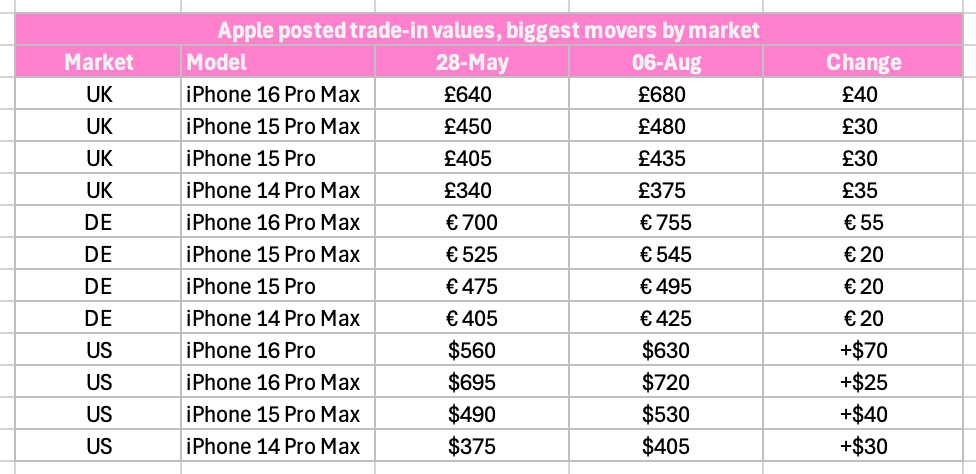
It’s hard to determine cause on paper, but perhaps the beginning of a response to the lower sales, Apple’s trade-in prices moved on again in August and the pattern flagged in May has intensified across all three markets. The UK produced 19 rises against 4 falls and 8 flat, with the 16 Pro Max up £40 to £680 (now above its £670 level from October last year), the 15 Pro Max up £30 to £480, and the 14 Pro Max up £35 to £375, its first rise in the last three updates. Germany moved from muted to unambiguously upward at 18 rises, 2 falls and 10 flat, led by the 16 Pro Max jumping €55 to €755. The US produced the cleanest trend with 27 rises, zero falls and 5 flat across 32 devices, with the biggest single mover in the file being the US 16 Pro, up $70 to $630. Two consecutive upward updates might still be the very beginning of a pattern rather than a confirmed one, and the September iPhone 18 launch is an equally likely driver. I'll be capturing values immediately before and after the launch and bringing the full analysis together in a standalone piece in October.
Apple’s ability to increase trade-in prices is a clear demonstration of the iPhone’s resilience in the secondary market. Dipli’s second edition of their Signals series looks at how iPhone values have moved over the past year and also confirm the direction is up. Across the three most recent versions at 256GB, 24 month residual values are running at 43% for the iPhone 14, 45.5% for the iPhone 15 and 47% for the 16 versus a premium smartphone norm of 35%.6 At 12 months the series is a bit less orderly with the iPhone 14 at 53.5%, the 15 at 57.4% and the 16 at 55.8%. They also predict a 12 month rate at 64.7% for the iPhone 17 which is way above the range the previous three generations have occupied. Dipli read the rise as an Apple trajectory. True. I’d add the same shortages that suppress supply push residuals up and there are plenty of drivers right now.
Companies
Plenty of Q2 results in over the month. Here are a few of the main sector relevant highlights:
Assurant Q2 2026
Assurant's Connected Living business, which sits inside Global Lifestyle alongside Global Automotive, posted net earned premiums, fees and other income of $1,554.5m, against $1,326.4m up 17.2% and 17.1% excluding currency. Adjusted EBITDA was up 29.3% to $170.4m which included a client adjustment and an international tax benefit in mobile totalling around $10m. Excluding those two items, earnings were up 22% which shifted the EBITDA margin from 9.9% to 10.3% on a 17% revenue increase. International net earned premiums, fees and other income across Global Lifestyle reached $668.3m, up 20.5%, versus domestic growth of 6.0%.

Assurant explained that higher volumes in domestic supply chain programmes were the driver of both the $92.4m increase in Global Lifestyle fees and other income, to $507.3m, and the $71.2m increase in cost of sales, to $302.6m. The cost side grew faster, 31% against 22%. Devices serviced stand at 7.4m, up 32.1% year on year but unchanged sequentially, and the table shows where the step actually happened: 4.8m in the third quarter of 2025, 6.7m in the fourth, then 7.4m twice. That looks like the T-Mobile reverse logistics programme and the co-located facility reaching their run rate, with the newer programme wins yet to show. It also leaves a soft base for the third quarter comparison, which will flatter the year on year figure that Assurant is due to report in November. Asked how the margins on the reverse logistics work compare with the core device protection business, CFO Keith Meier stated the protection programmes are the drivers of the economics and the supply chain work is a complementary element. On the component cycle he was more forthcoming, describing higher memory costs and higher new device prices as neutral to positive over the longer term, because expensive devices raise the propensity to protect and widen the demand for certified pre-owned stock. I'd cautiously offset that against the longer hold-times and suggest we'll probably come out closer to neutral than positive.
Allstate (Protection Plans) Q2 2026
I’ve not checked in on Allstate’s Protection Plans business (including SquareTrade) for a while. Their Q2 reported revenue was up 9.2% in the quarter to $615m, and premiums earned up 8.9% to $578m. Adjusted net income fell 17.6% to $42m which is explained in the 10-Q by lower margins on major appliances. Claims and claims expense rose 20% to $156m, taking the loss ratio against earned premium from 24.5% to 27.0%, while amortisation of deferred acquisition costs and non-deferrable commissions together moved from 59.7% of earned premium to 61.8%, suggesting that selling policies is getting a bit more expensive. The headline policy count of 168.7m, up 3.9%, carries a footnote: it includes 2.9m policies primarily relating to periods from September 2025 through March 2026 that were not in previously reported numbers. On a like for like basis the increase is closer to 2%, and the sequential addition falls from 3.5m to around 0.6m. Premiums earned are therefore growing well ahead of units, which puts price and mix rather than volume behind the top line increase. Allstate reports Protection Plans as one revenue line and one earnings line, so there is no way to see which categories are carrying that pricing or how the appliance book compares with electronics. What is visible though, is a protection book where the claims side has moved faster than the pricing response, and a distribution cost that is rising as a share of premium at the same time.
AT Renew Q2 2026
After I reported on ATRenew’s FY2025 results, I continue to keep an eye on them and I think you should too. Q2 results were published on 20th August with total net revenues up 32.4% to RMB 6,609m (USD 974m), and 11.6m products transacted against 10.3m. Subtract merchandise costs from product revenues and the first-party gross margin comes out at 15.7%, versus 13.2% a year ago and 13.8% for the whole of 2025. Separately, on 28 July ATRenew launched FoneSquare, a cross-border B2B marketplace, and ReRe, a consumer brand with a first store in Tsuen Wan, with Hong Kong and Dubai as distribution hubs and inspection equipment planned for Miami too. FoneSquare is PJT rebuilt for export, and the fourth phase of the plan is a shift to a fee-earning platform model.7
Foxway Q2 2026
After Foxway’s C&E Recommerce division carried the company through Q1, it was good to read that things turned out to be a little more evenly distributed over Q2.8 Group net sales were up 12.4% to SEK 2,092.5m (€180.4m), or up 13.0% at constant currency and stripping out the ABD acquisition effect. Adjusted operational EBITDA rocketed 281.9% to SEK 93.4m (€8.1m), at a margin of 4.2% from 1.3%. Operating cash flow improved to SEK -4.6m (€-0.4m) from SEK -99.3m, although management flagged a timing effect on late-quarter invoicing.
All three segments delivered positive operational EBITDA in the same quarter for the second quarter running. CWS net sales rose to SEK 623.7m (€53.7m), up 12.5% constant currency and adjusted operational EBITDA improved to SEK 13.5m (€1.2m) from SEK -8.8m, at a 1.8% margin. The second consecutive positive quarter. Recommerce C&E net sales were up 39.8% to SEK 813.6m (€70.1m), or 41.5% organically at constant currency, and adjusted operational EBITDA came in at SEK 59.0m (€5.1m), with margin down to 7.3% from Q1's 10.1% as memory prices corrected on the timetable Höijer gave in the Q1 letter. Teqcycle revenue more than doubled year-on-year. Recommerce Mobile’s net sales were down 8.9% to SEK 679.7m (€58.6m) reported and 8.1% constant currency. Adjusted operational EBITDA was SEK 56.9m (€4.9m), with margin up to 8.4% from 4.5%. Management attributed volume weakness to tight trade-in supply and framed it as prioritising profitability over volume. Restructuring costs of SEK 13.5m in the quarter sat primarily inside Recommerce Mobile.
There were, of course, a raft of operator results including the equipment sales, but that’s for another time.
Other Items
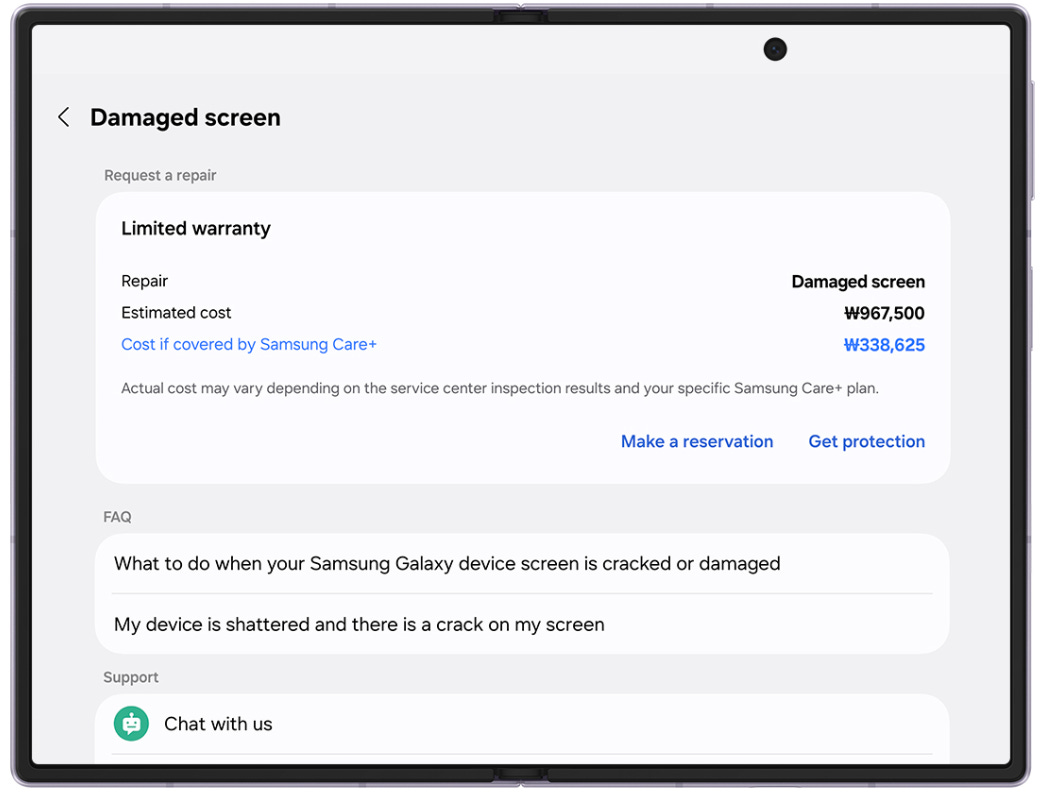
Samsung look to have upgraded the interface for warranty care on their new foldables. According to the report Warranty and Care, introduced with One UI 9, centralises device management features, letting users check warranty status, run diagnostics, book repairs, and get support without leaving Settings.9 The report only mentioned the UK with bolttech and AmTrust Specialty Limited supporting the SamsungCare+ processes. Despite the screen grab suggesting that UK users will be able to pay in Korean Won, any attempt to reduce friction in the after sales process should be applauded.
Around this time last year, Reboxed announced a partnership with Uswitch, the UK comparison service that helps customers select competitive utility, insurance and personal finance products.10 They also cover SIM only phone contracts and mobile phone deals, both new and refurbished. Which was where Reboxed come in. USwitch have now partnered with Back Market creating a pool of refurbished phone suppliers apparently offering more consumer choice.11 Devices are presented in the usual cart format with variant selection completed on the Uswitch site and an indication in the payment summary of who you’re buying from. I’m assuming the supplier selection is based on product and variant availability and according to the Mobile News report, Uswitch are evaluating other retail partners. Comparison sites sitting above marketplaces, sitting above refurbishers and repairers sitting above wholesalers and traders seems to me to be adding more links to the value chain without really adding much value. And here’s me thinking the sector should be consolidating…


Right, that’s me done for this edition. Hope you all had a great summer, survived the heat and are appreciating some cooler weather.
Peace,
sb.
Check out the call transcript at: https://www.verizon.com/about/investors/quarterly-reports/2q-2026-earnings-conference-call-webcast