

Wimbledon is over, I’m another year older, we’ve got our seventh prime minister in 10 years, it’s officially been declared that we’re in a drought, and according to VMO2, more than 18 million Brits were targeted by scams in just three months,1 in my personal experience mostly from scammers claiming to be from O2. The irony…
Markets
Less ironic is the continued pressure on the smartphone market with Counterpoint noting a 15% YoY decline for system on a chip (SoC) shipments for H1 2026.2 There appears to be no respite from rising memory costs, which Counterpoint put at more than 300% year-on-year in Q2 2026. Consequently, according to Counterpoint, more cautious inventory management at the Smartphone OEMs is compounding the impact, as are longer replacement cycles. I looked at the potential impacts of the chip shortage on the secondary market in more detail last month and found the same thing: over the medium term, the shortage compounds the existing hold-time extension, and is likely to hit secondary market quality as well as volume. Memory now costs more than the SoC in every segment, so the rise in build cost gives the customer nothing new. Counterpoint's bill of materials comparison between the iPhone 17 Pro Max and the estimated iPhone 18 Pro Max provides a decent explanation.3
MM Research Institute in Japan have some cheerier reading where used smartphone sales were up 12.4% to the year ended March 2026 at 3.607m units.4 Set against new shipments of 31.33m, that takes the used share of combined volume to 10.3% with 3.96m units forecast for FY2026 and more than 5m by FY2029, at which point MMRI expect the used share to pass 15%. The drivers they cite are the weak yen, continued price inflation, successful carrier certified used programmes and growing corporate demand. The memory shortage and OEM certified programmes get a mention as drivers of future uptake which means the FY2027 result, next year, would be the first to carry the effect that Counterpoint are describing. It’s worth remembering too that Japan has long been a net exporter of secondary market stock with companies like Aucnet growing their distribution capabilities across multiple markets, including Europe. If domestic absorption continues growing at close to 10% per year, there might well be far fewer devices available for export. Additional reporting here.
Dipli published their incredibly useful updated price index for S1 2026 at the end of the month, which puts their own transaction data behind the argument I made on the chip shortage a few weeks back.5 The index fell only 10 points over the half, with the usual post-Christmas correction shallower than in previous years and prices easing through Q2 before stabilising in June. Prices turned up again on the mainstream iPhone models (13 to 15 and Pro variants at 128GB), as summer demand met tighter sourcing and falling trade-in volumes. The number that caught my eye though was the average trade-in value, up from €141 in S1 2025 to €153. Twelve euros, or about 8.5%, against new device increases forecast in the hundreds. I think Dipli read the residual value trend as structural, and I still expect the shortage to lift used values in cash terms. What I doubt is that they rise in step with launch prices. If new device prices rise on memory costs alone the buyer of a two-year old device is being asked to pay more for nothing they can see. Either way, twelve euros will not hold the cost of upgrading steady, and that gap is the thing I keep coming back to.
I also keep coming back to the lack of anything from the UK government’s Circular Economy Taskforce including the much delayed Circular Economy Growth Plan. The news that Mary Creagh as the Minister for Waste and the Circular Economy is now to be replaced by Emma Hardy as Minister for the Circular Economy and Waste Crime, doesn’t give me much confidence that things will speed up.6
Whilst the alarmist nature of this headline might be entirely appropriate for an ITAD conference filled with companies concerned about rescuing the world’s scarcest resources, it turns out they just meant rooms at the Bellagio.

Companies
Apple Q3 2026
There’s plenty of analysis around covering Apple’s Q3 2026 result, but it feels a bit churlish not to offer a couple of observations. iPhone revenue came in at $54,252m up 21.7% (Q3 2025: $44,582m), a third consecutive quarter exceeding 20% growth. Products gross margin, the gap between what the hardware sells for and what it costs to make, rose to 40.1% (Q3 2025: 34.5%), which could be read as Apple passing memory costs through. However, Apple has been recovering tariffs since February’s Supreme Court ruling and books the refunds against the cost of making its products.7 At roughly two percentage points of company margin, and with all of it in the Products line, the underlying products margin would be below 37.5%, and so below the 38.7% of the March quarter rather than above it.8 Increased chip costs are landing on Apple, no doubt, which is presumably why their risk factors now describe price increases as actions already taken, rather than actions that might be, and why component inventory has gone from $2,124m to $7,645m in nine months, while finished goods remained flat.
So, who is buying all the iPhones? Omdia have Apple shipping 55.1m units, up 23%, for a record 20% share of a market that’s down 6% overall.9 Counterpoint offer the same record market share, but off a much lower shipment growth of 3% against a market down 11%.10 Quite a difference, but I suspect the gap most likely sits in how much of the quarter remains stuck in the channel. Omdia report distributors building significantly higher inventories of the base iPhone 17 ahead of the expected price rises and a dearer iPhone 18. That sounds plausible set against Ingram Micro for example, whose inventory build over the same twenty six weeks ran to $1,109m against $624m a year earlier, funded by drawing down a revolving facility rather than by stretching its own suppliers.11 Apple’s remaining iPhone sales are down to geography. The filing attributes the Greater China increase of $3.45bn primarily to iPhone and the Japanese increase of $772m to iPhone alone. Around two fifths of the iPhone growth was down to two markets leaving a much smaller number for the US and Western Europe than the headline implies.
So what might all that mean? Devices sitting in distribution have not been sold through, so the trade-in and protection flow this quarter implies starts later and will be smaller than the shipment numbers suggest. Around two fifths of the growth went to China and Japan, and a Japan absorbing more devices domestically is a Japan exporting fewer. Apple has $5.5bn of components brought forward and Samsung have guided the shortage through 2028, which is likely to put every refurbisher and repairer behind them in the queue for original manufacturer parts.
Samsung Q2 2026
Samsung’s reported group revenue of KRW 171.5tn (~$120bn) and operating profit of KRW 89.5tn (~$63bn) which were both records, at a 52.2% margin. Beneath that, the mobile and networks business (DX/NW), grew revenue 14% to KRW 33.2tn (~$23bn) and posted an operating loss of KRW 0.7tn (~$490m) against a KRW 3.1tn (~$2.2bn) profit a year earlier.12 The DX/NW margin sequence is now 10.6%, then 7.3% in the March quarter and minus 2.1% this time around. With networks improving both sequentially and year-on-year on overseas sales, the mobile business on its own is worse than the combined number lets on. Management attribute the decline to elevated component cost pressure across the industry. The other side of those costs, the revenue, largely went across the hall as Device Solutions (DS) turned in an operating margin of 70%, and of the KRW 84.8tn (~$60bn), by which group operating profit grew over the year, DS accounts for KRW 88.8tn (~$62bn), so semiconductors delivered more than all the group improvement and everything else went backwards.13
On how long this lasts, Samsung are unambiguous. The memory business expects the market to remain undersupplied through the second half of the year on server DRAM, enterprise SSD and HBM demand, despite what it calls partial demand moderation in mobile and PCs, and supply constraints will persist despite efforts to raise production. Samsung’s CFO put 2027 tighter than this year with the shortage running through 2028.14 Set against the persistent BoM inflation, the second-half plan for mobile is flagship-first expansion centred on the Galaxy Z8 and S26 series, a premium mix push across the Galaxy ecosystem, Intelligent Eyewear (really), and mitigating efficiency initiatives. Good luck if you’re on their supply-side. In April, I read Samsung’s language on foldables as a quiet admission they were not landing near their targets. Whatever the position was then, the answer now appears to go at them harder, with a Fold8 Ultra added to the range.
The Apple comparison is instructive. Samsung’s mobile revenue grew 13.3% on shipments up 5%, so effectively, prices rose by around 8%. But, the company with the memory division still lost money. Apple’s iPhone revenue grew 21.7% on shipments up 23%, so its prices went nowhere and it took a record share. The company buying memory at arms length, held prices and gained share having put $5.5bn into components ahead of the shortage biting. Xiaomi, OPPO and Vivo with neither the captive supply or the same purchasing power were down 26%, 17% and 18% on shipments.
Other Items
In addition to the financial results, there were a few more notices from Apple in July. First was the Apple Upgrade programme announced in the US on 28 July, with Klarna as the lessor, covering iPhone, iPad, Mac and Apple Watch.15 It replaces the current iPhone Upgrade Programme and iPhone Payments. Terms are 12 or 24 months on the iPhone and Watch and 24 or 36 months on the iPad or Mac.
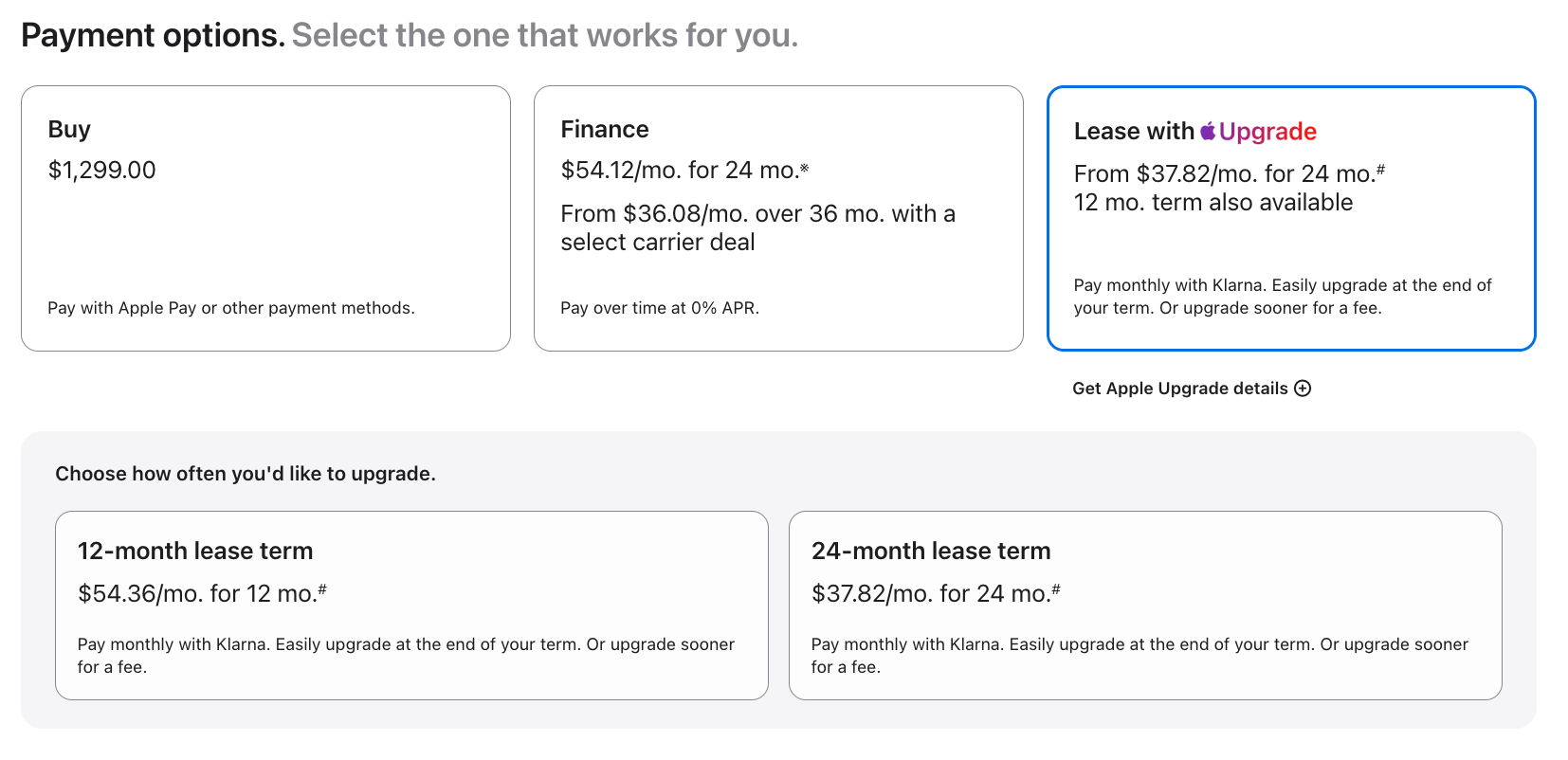
The buyout mechanism is worth looking at. The Apple FAQ states the purchase option fee is the full price at lease signing, less the payments made, plus tax, with no finance charge inside the monthly payment.16 The payment sets the buyout price. On an iPhone 17 Pro 512GB at $1,299, 24 payments of $37.82 leave $391.32 to own the device, or 30.1% of list price. The 12 month term leaves 49.8% of the list price. On any plausible depreciation curve the device is worth appreciably more than that, which makes buyout the default option for anyone that bothers to check, and Klarna gets back some phone shaped gold bars from customers that didn’t.
The old iPhone Upgrade programme bundled AppleCare+ with Theft and Loss into the monthly payment. This one doesn’t. The device is assessed on return, I assume by Apple’s processing partner(s), and Klarna will charge a damage fee. Theft or loss events without cover leave the customer owing the full buyout. AppleCare is now covering a return liability to a lessor, not just the cost of a repair.
Karl Gilbert at Raylo read the launch as access over ownership going mainstream,17 whereas Cliff Raskind took it as a signal about Apple's expectations of upgrade demand, since the structure only holds up if premium iPhones retain value at two years, which is not what you would price if you expected the next few launches to drive a wave of replacements.18 On the published terms, the residual exposure appears to sit with Klarna. But, I have no insight into what, if any, residual risk or end-of-lease devices might be transferred between Apple and Klarna, or other third parties. The plainer reading is the one that Jitesh Ubrani at IDC gave in the NY Times: with memory costs where they are, a monthly figure is easier to sell than a price.19
Second, after all that lot, was Apple UK’s quick fire release of their AppleCare+ and AppleCare+ with Theft and Loss terms and conditions.20 Three iterations in a month is worth a mention, but it’s worth a longer mention than I can reasonably explain here. So I’ll probably write something specific on that.
Back to Samsung again, sorry. Eight days before Apple’s upgrade announcement, Samsung Electronics America and Barclays launched the Samsung Galaxy Card, Samsung’s first US credit card, issued on Visa and provisioned directly into Samsung Wallet.21 The release describes it as bringing new financing options for Galaxy devices and appliances, although it appears to offer a rebate rather than a financing structure. Whilst the mechanics are very different from Apple’s latest financing approach, the direction of travel is the same: moving the transaction to the manufacturer’s own channel.
The telco’s quarterly results are beginning to trickle in. There’s a summary from Runar Bjørhovde on the US results focusing on equipment revenues here which will suffice before my next Equipment Revenue tracker due at the end of August-ish. In the UK VMO2 released their Q2 results with hardware and other revenue down 21.5% to £356.1m (Q22025: £453.8m), reported, and down 25.4% adjusted for Daisy.22 We’ve also got to strip out network construction and other revenue which fell from £82.9m to £3.4m as the nexfibre build wound down as it sits in the same line meaning that hardware and other falls from £370.9m to £352.7m, down 4.9%. Additionally, consumer revenue less consumer mobile and fixed service revenue gives £259.9m against £289.0m, down 10.1%. That includes handset insurance and other fees alongside equipment, but now VMO2 are hiding the handset sales, it is the nearest thing to a proxy I can muster on this set of accounts. What with mobile consumer contract connections falling (54,300) in the quarter to 12.47m and ARPU flat at £17.81, it’s no wonder the bond holders are beginning to get jumpy.23 The new O2 Tech Refab Lab at their experiential flagship store in Stratford (London), is part of a trial to help shoppers better understand trading-in, extending device life and great value “like new” device options.24 I’m all for any action that contributes to improved trade-in rates and offers consumers alternatives to the drawer, so I hope, whatever lessons learned get rolled out more widely. Good luck to them.
More on trade-in with Foxway running next generation trade-in pilots in Germany, Finland, Poland and Croatia, combining AI visual inspection with Apple diagnostics to deliver “up to 17% higher residual [sic] values”.25 Whilst not the whole of the upgrade cash gap, against the €153 European average above, that’s around €26, twice what the market itself added in a year and it comes from grading precision, rather than a promotional subsidy. I think this is the first tangible uplift I’ve seen this year without someone funding the difference. One to watch.
Apkudo launched its RSA appliance on 7 July, engineered by Alpha Automatics and running on Apkudo's Device OS.26 It processes smartphones, tablets, flip devices and foldables on one system without reconfiguration between runs, using torque sensors and acoustic capture for foldables and stitched imaging for tablet displays, at up to 30 devices an hour. Two things caught my eye. The cosmetic models are stated as compliant with CTIA 5.1, the standard I argued in June is the closest thing Europe could adopt to a consumer-facing grading language, though with the material exception of common consumer facing grade descriptions. Apkudo’s new kit is pitched at operators processing as few as 5,000 units a month, fitting through a standard doorway, which puts automated foldable grading within reach of regional processors rather than the large centres. Early deployments name Likewize, MTR and TMT First.
Whilst perhaps not at Byron’s levels of commitment, I am a proud philhellene and could happily spend the rest of my days wandering through the Arcadian mountains or the back streets of Chania, standing in Nicopolis in Epirus and realising the history that led to its creation… you get the picture. All that to say my support for all things Greek, runs deep. But, I have to question telecom operators moving into personal lines insurance.27 Brands can only stretch so far, and the news that Cosmote Telekom have launched a complete suite of insurance propositions, including broking (term & whole) life insurance, caught me out. I wish them every success and sincerely hope they do better than Telefonica’s foray into home insurance.
Right, if you’re still here, good effort, but I need to wrap up. Samsung (sorry) have partnered with AmTrust Risk Solutions to offer the Samsung Care+ programme across Canada.28 mResell have joined forces with Reuse Technology Group to access the UK market.29 SquareTrade Europe have opened up an office in Brussels for their new licensed insurance undertaking.30 The move brings underwriting capabilities in house for the first time, and adds another value chain capability in addition to trade-in and upgrade via the Kingfisher acquisition. Steve Oliver, musicMagpie co-founder, is set to step down after the sale to AO.com.31
I’m taking a couple of weeks off to recharge the brain space and spend time with the fam. If you happen to be taking a break over the summer, I hope that you stay safe, stay healthy and get time to read a few articles from the back catalogue.
Peace,
sb.
Finsur is a reader supported publication. Please consider subscribing:
Comments attributed to CFO Sooncheol Park on the 30 July earnings call, reported at https://www.lightreading.com/finance/samsung-reports-63b-profit-but-mobile-unit-sinks-to-loss