

Key findings:
- CTIA V5.1, published 10 June 2026, is the only operational consumer-facing device condition standard in use, and it is American and voluntary.
- Europe regulated the front of the device lifecycle, design, repair, provenance and waste, but left condition grading, the variable that sets secondary-market value and risk, to the market.
- The Digital Product Passport will not close that gap: created by the ESPR (EU) 2024/1781 to carry provenance and sustainability data, it captures no cosmetic or functional condition, and no smartphone passport is due before the end of the decade.
- Europe is a net importer of used devices, much of it stock from US carrier auctions already graded against CTIA, so the standard is positioned to become the European grading language by trade rather than by legislation.
- CTIA’s reservation of its top tier for genuine parts runs against the EU Right to Repair Directive (EU) 2024/1799, which from 31 July 2026 protects independent repairers’ use of compatible and second-hand parts under Article 5(6).
- Private grading platforms prove the demand for a condition standard but cannot supply one, since each standardises within its own walls and diverges from the rest.
- The workable route is to adopt the CTIA standard and adapt it for Europe rather than author a competing one, with EUREFAS the natural convener and GSMA’s identity registries the layer beneath.
Presentations and panel discussions on the conference circuit have long been dominated by device grading. Retech Days in Berlin recently was no exception and even if the session titles weren’t explicit, discussions in both the D2C and B2B streams often returned to the importance of grading in building and maintaining credibility and trust. Despite me wishing the conversation would move beyond your excellent versus my pristine, there is obviously more work required to deliver consistent product standards and service on both sides of the trade-in and sales transaction.
This last came to mind six months ago when I was writing the Caveat Emptor article about my own purchase experience. Back then, the latest CTIA version 5 and SERI R2v3 standards had been exquisitely engineered for B2B trading and yet remained some distance from anything likely to catch on with the consumer in mind. But, six months is a long time in the secondary market and on 10th June, the CTIA announced the publication of version 5.1 of the Wireless Device Grading Scales Criteria and Definitions1 which fixes a consumer-facing tier on top of the wholesale scales.
The latest release was positioned as a “global standard”, although given the limited international participation, I assume global means comprehensive rather than world-wide2. However, with the EU’s Circular Economy Act 2026 wrapping itself around various sets of design principles, EUREFAS delivering influence and policy notes, and the UK operating in a policy vacuum, perhaps the latest CTIA release is worth a closer look…
CTIA V5.1 reaches the consumer
The CTIA Wireless Device Grading Scales Criteria and Definitions is a voluntary industry standard that does one thing: it defines, in its own words, “a common lexicon and process for grading wireless devices.” It’s not a law and not regulation, rather a shared vocabulary that allows for a device’s condition to be described consistently by every party that handles it. As long as it’s applied consistently. The standard is developed by the CTIA's Reverse Logistics and Service Quality (RLSQ) Working Group3 and has been steadily revised since first appearing in December 2018.
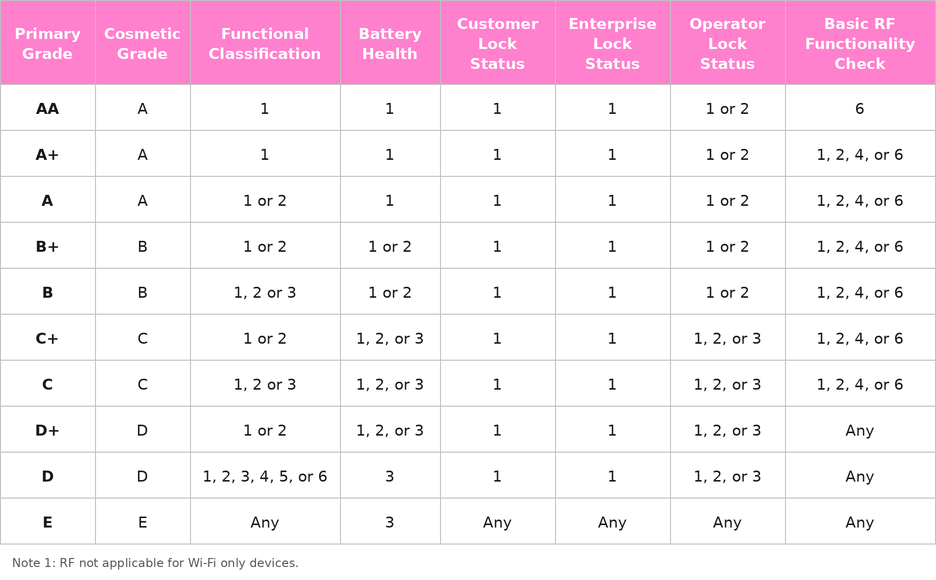
Eight years of practical iteration is valuable. The CTIA standard splits condition into two independent axes. Cosmetic grade describes the physical state of the device’s surfaces, and functional grade describes whether the device and its components work. A device therefore carries a grade on each axis and the two values are combined into a single headline grade rather than collapsed into a single impression. Around the two axes there are a number of further checks that feed the overall grade: battery health with its own recommendation for Europe, whether the device is encumbered with a lock and a basic radio-frequency check.
Version 5.1 includes two important updates. First is the inclusion of genuine (OEM or OEM-approved) and non-genuine (third-party) parts which sits only in the consumer layer, not the wholesale grade. The second update maps the wholesale cosmetic and functional grades to a set of direct-to-consumer ratings, which is the first time the standard has addressed the retail buyer. The consumer layer has four tiers and applies only to fully functional devices with each tier bundling more than just the cosmetics: a battery-health floor and a parts condition travel with the grade. Tier 1 requires a 90% battery and genuine parts. Tiers 2 to 4 require 80% battery, with disclosure where parts are not genuine.
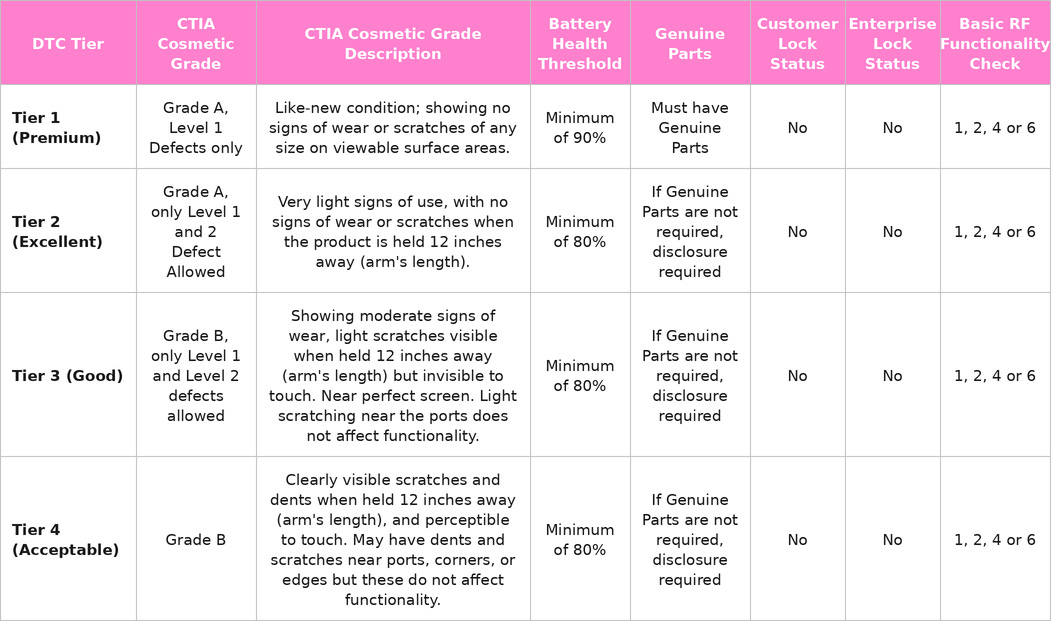
Whilst the tiers are clearly and objectively defined, sellers have the freedom to attach their own description. In the standard, Tier 1 is described as “Premium”, Tier 2 as “Excellent”, Tier 3 as “Good” and Tier 4 as “Acceptable”. However, these names are given as examples only. That two sellers can label the same tier differently or different tiers alike without breaching the standard is, unfortunately, a fudge. The consumer layer is definable, but not consistent, precisely when consistency is important.
The standard reaches into European conformity by defining CE (Conformité Européenne) in EEA terms which suggests that Europe was in the drafters’ field of view, though only as a reference rather than a compliance mechanism. The kitting guidance also lists CE and UKCA, though again, only as examples of safety marks accessories should meet where applicable. This side of the pond was also in mind with the standard recommending an 80% battery-health threshold for Europe against 70% generally and citing the EU ecodesign regulation as rationale.4 That figure is seemingly borrowed from a regulation that sets 80% as a durability requirement for new batteries, not a grading floor for used devices, which is already being exceeded in retail by the likes of refurbed, flip.ro, Recommerce and Swappie.5
CTIA reserves its consumer tier 1 for genuine, OEM or OEM-approved parts, with disclosure required at the lower tiers. This places OEM parts at the top of the value hierarchy just as the EU Right to Repair Directive (2024/1799), applying from 31 July 2026, is about to bar manufacturers from impeding independent repairers' use of compatible and second-hand parts in phones and tablets.6 The directive protects the legitimacy of non-original parts rather than promoting them, posing a tension between two regimes: a device given a quality independent repair with a compatible part remains lawful and saleable in Europe yet falls outside CTIA's top tier.
The layer Europe left to the market
The EU has been regulating the start of the device lifecycle comprehensively: design, repairability and waste, and with the incoming DPP, provenance and sustainability. All of these are due to align, much like the stars, under the Circular Economy Act 2026.7 Cosmetic and functional condition, the variables that drive secondary market value and risk, have been left to industry and without much practical agreement given the perceived advantages in exploiting grade ranges in an overtraded, thin-margin commodity transaction.
I’ve been concerned for a while that with respect to smartphones and other consumer electronics, the EU Digital Product Passport (DPP) has been carrying some expectations that the legislation itself was not destined to fulfil.8 The DPP is created by the Ecodesign for Sustainable Products Regulation (EU) 2024/1781 (ESPR)9, but only as a framework. Article 910 is the legal basis, and Annex III lists the categories of data a passport can carry. The specific fields, and whether a DPP applies to a given product at all, are set by product-specific delegated acts adopted under the Regulation.
For smartphones, no such delegated act yet exists. They currently sit under the Ecodesign Regulation (EU) 2023/1670 and the energy labelling Regulation (EU) 2023/1669, applying from 20 June 2025, with product information currently carried through the European Product Registry for Energy Labelling (EPREL) database and an energy label showing an energy efficiency class and a repairability class. Electronics were not a priority group in the first ESPR Working Plan 2025-2030 (COM(2025) 187 final, 16 April 2025). Instead, they might only be covered by the horizontal measures on repairability and recyclability of electrical and electronic equipment, indicatively 2027 and 2029, with electronics a possible addition at the 2028 mid-term review.
The framework caps what data any future smartphone DPP could carry. The required delegated act specifies the data to be included pursuant to Annex III, and every category on that list is either provenance, identity, traceability and compliance, or the sustainability information that Article 7 routes into the passport: the repairability and durability scores, the footprints and the substances of concern. Cosmetic and functional condition appears nowhere today. The closest it comes is the battery cycle-life, but that’s a measure of durability at new, not a live measurement. As it stands, the most a smartphone DPP will be able to offer is data that can be fed to a grading process.
The private answer
The market is not bereft of condition data. There’s an extremely dense vendor layer sitting between intake and resale that conducts diagnostics, certified erasure and grading. There are the repairers and refurbishers that grade according to their own standards who could also add plenty of parts and processing data to the stack. Then there are the retailers who present their own grades to the consumer. Some have bought the capability outright. Recommerce, among Europe's larger refurbishers, acquired the smartphone diagnostic app DealCertify in 202111, now the in-house engine testing every device it handles.
Functional testing is effectively commoditised with near-identical and ubiquitous 1-100+ point test suites and certified erasure to ADISA, NIST and R2 standards from Blancco, Piceasoft, Phonecheck, NSYS, BitRaser, FutureDial and so on and so on. Cosmetic grading, the one condition that Europe has no standardised scale for, also has its own automated sub-industry of AI vision systems. Apkudo, Phonecheck and NSYS (Reeva) pair cosmetic grading with functional testing and erasure, while FutureDial's SMART Grade and OptoFidelity's SCORE are cosmetic-grading systems alongside them.
But every platform standardises inside its own walls, and so diverges from every other. Even the cosmetic graders vary output through client-configurable bands. NSYS Autograding lets each operator (client) decide how grades are assigned and how many to have12 and notes there is no grading standard in the industry: the same phone that one company grades B, another grades C.13 Apkudo’s own paper acknowledges that in trader-to-trader markets the labels A and B mean different things to different sellers.14 The fragmentation is a symptom of a conveniently absent standard, and automation seemingly removes subjectivity with one hand and quickly reintroduces it with the other. Quite the example of circularity.
Alongside private grading standards, the industry bodies that might have stepped in, either stepped around or didn’t step at all. The GSMA’s registries, Device Check, the Block List, IMEI and TAC govern identity, not condition.1516 CEN-CENELEC17 and ETSI18 work the technical and process standards, not a consumer grade and EUREFAS19 names quality standards in its mission but faces a challenging member-competition coordination problem.
Having spent the last week looking at the various approaches, it appears that Apkudo offer the most expansive private answer that goes past grading to the data layer itself. Josh Matthews and Chad Gottesman’s paper frames the passport as a connective platform, and the trademarked Device Passport offers an operating system that aggregates condition, diagnostics and history across the lifecycle: the first bid to bridge from passport to condition. Yet in every other asset class where value turns on condition, the problem was settled long ago through an independent standardised authority: graded coins on the Sheldon scale, trading cards through PSA and Beckett, diamonds by the GIA's four Cs, used vehicles by standardised inspection grade, which frames Europe's mobile condition gap as a coordination failure rather than a property of the product.
Grading by trading
The already extensive cross-border trading of used devices is more than likely set to increase as consumer demand continues to rise and regional supply continues to vary. And although B2B trading generally works as is, diverging standards only increase friction as you get closer to the consumer. With the commonly cited goal of improving credibility and trust, a common consumer-facing condition language serves that directly.
Without an emerging European or UK standard to apply, the only operational consumer-facing vocabulary in use is the CTIA's DTC tiers and SERI's cosmetic C-series, with many imported devices originating from auctions by US carriers, also involved in developing the CTIA standard. Adopting and adapting it would seem to make sense, working with the grades that the stock already carries across the pond and reducing some of the logistics friction at the same time.
So, let’s adopt the CTIA’s V5.1 standard rather than author a competing European one and adapt the element they left open by agreeing a single description for the consumer tier, for example: Tier 1: Pristine; Tier 2: Excellent; Tier 3: Good; Tier 4: Acceptable. The substance behind each CTIA tier and grade pairing might need a bit of buff and polish to improve consumer friendliness, but a centrally hosted free and public reference should be accessible to any business or consumer wanting to view the definition.
Of course, none of this carries the force of law. CTIA V5.1 is a voluntary American standard, so adoption would be a matter of agreement. That leaves the question of who convenes the agreement and holds the result. EUREFAS is the obvious candidate. Owning an adapted external standard is also a lighter request to make of competing members than authoring a grade of its own.
Whilst a common vocabulary settles what a grade means, it doesn’t move the record of a device between the businesses that handle it. That connective layer is a separate question and the one that the Digital Product Passport is often expected to answer but was never designed to. What the regulation does set, though, is the precedent any such layer should follow. The ESPR requires passport data to rest on open standards, interoperable and free of vendor lock-in, with free access along the chain and no reselling by service providers. The default should be open and neutrally held data and the capability to hold it in common already exists. Condition records need to attach to a device's identity, its IMEI and type allocation code and GSMA already maintains those as global registries.
Two owners then, by scope rather than rivalry: EUREFAS over the European language, GSMA over the global data beneath it. Neither has to invent anything, since neutrally governed passport data spaces already run elsewhere. Europe regulated the front of the device lifecycle and left condition to the market, and the market's own most-traded standard is the place to begin.
What to watch
The clearest alternative to a standard consumer grade is per-unit transparency: show the actual device to the consumer in store or on video and provide a verifiable, per-device report on provenance, cosmetic and functional condition changes. Phonecheck’s Device History Report and CheckMEND already do this, linked to the IMEI, though for identity and history not condition. Worth watching if more sellers switch from a grade and stock image to the specific unit and its report. Not easy or cheap, but viable.
It’s also worth watching whether the published référentiel of France's government-backed national label,20 developed by the DGE and ADEME and the sector bodies, evolves beyond certifying the quality of reconditioning, to add a condition axis. Additionally, as EUREFAS launched their own quality label and with Augustin Becquet stepping down as president,21 the incoming leader may have their own ideas to progress.
GSMA's February 2026 Innovation Fund backs traceability and take-back models, and Jason Smith is set to share specific steps on mobile digital product passports at a Mobile Disrupt roundtable on 6 July.22 Whether that places GSMA deeper in the provenance layer or charts a course into the condition data, we shall have to wait and see.
The EU’s Article 13 DPP registry obligation falls on 19 July 2026 and the Right to Repair Directive applies from 31 July 2026, although neither touches condition. The UK named electronics a priority sector but a Defra answer of 15 June 2026 still gave no publication date for the Circular Economy Growth Plan.23
All this points to the fact that the layer the EU/UK left to the market, is still being left to the market, and the CTIA’s 10th June announcement is the closest anyone has come to providing an accessible cosmetic and functional grading standard that bridges B2B trading and B2C retail. I’d say that’s worth a closer look…
Peace,
sb.
Finsur is reader-supported and the analysis takes time. Please consider a paid subscription and if not, a free subscription really helps with traction. Additionally, if you can find your way to leave a comment, or even a hit the heart for a like, it makes a big difference. Thank you.
Methodology
Sources. This analysis rests on the primary texts read directly rather than on secondary coverage of them. The standard under discussion is the CTIA Wireless Device Grading Scales Criteria and Definitions, Version 5.1 (June 2026), including its revision history, the direct-to-consumer mapping at Appendix A and the R2v3 cross-reference at Appendix B. The European framework is drawn from the Ecodesign for Sustainable Products Regulation (EU) 2024/1781, Articles 7 and 9, Annex III and the digital product passport provisions; the ecodesign and energy labelling Regulations for smartphones and tablets, (EU) 2023/1670 and (EU) 2023/1669, applying from 20 June 2025; the Right to Repair Directive (EU) 2024/1799, Article 5(6); and the first ESPR Working Plan 2025 to 2030, COM(2025) 187 final. The attribution of the standard’s authorship and the global standard positioning rests on CTIA’s press releases of 11 February 2019 and 10 June 2026. The private grading layer is described from vendor and sector materials and from Apkudo’s 2026 paper on the digital product passport. The position of France’s national label is taken from sector bodies, no published DGE criteria document having been located. The UK position is taken from a Defra written parliamentary answer of 15 June 2026.
CTIA Version 5.1 is distinguished throughout from the prior Version 5.0 of July 2025, and each European instrument is identified by number, the relevant article and its application date. The piece carries no converted financial data and cites no operator accounts, so no currency or accounting basis applies. Where no defensible figure exists the analysis rests on the qualitative thesis rather than a forced number. Interpretation is carried in the author's voice and kept distinct from what the sources themselves state. The subject is consumer-facing condition grading for smartphones and tablets in the European secondary market. Detailed business-to-business grading mechanics, non-mobile categories and wearables, though within the CTIA standard’s scope, sit outside this piece, as does any assessment of named bodies as organisational performance; the treatment is thought leadership rather than critique.
Commission Regulation (EU) 2023/1670 of 16 June 2023 laying down ecodesign requirements for smartphones, mobile phones other than smartphones, cordless phones and slate tablets, Annex II. OJ L 214, 31.8.2023. https://eur-lex.europa.eu/eli/reg/2023/1670/oj/eng
Directive (EU) 2024/1799 of the European Parliament and of the Council of 13 June 2024 on common rules promoting the repair of goods, Article 5(6). OJ L, 2024/1799, 10.7.2024. https://eur-lex.europa.eu/eli/dir/2024/1799/oj/eng
Apkudo, "The Real Value of the Digital Product Passport: You're Asking the Wrong Question", 2026, p. 13, "The Intelligence Gap".