

Key Findings: Eleven European CE recommerce operators compared on warranty, insurance, battery guarantees, trade-in and beyond-the-transaction propositions, benchmarked against Apple Certified Refurbished and Samsung Certified Renewed. Service provision varies widely; insurance is the most underdeveloped dimension with four operators offering nothing and only five carrying regulated cover. OEMs set the benchmark on battery, protection and integrated trade-in that the sector is beginning to match. Full financial analysis of all eleven operators, including revenue, margins, net results and strategic outlook, is available as a downloadable report at reports.finsur.co.uk.
There’s no doubt that despite everyone’s best sustainability efforts, the majority of buyers opt for a pre-loved device because of the price differential. We might wish otherwise but, given the economic backdrop over the last few years, it’s an unsurprising consequence of squeezed disposable incomes and incremental technology developments that might offer a few more pixels.
Still, with 63% of refurbished buyers preferring pristine or certified condition devices (whatever that currently means)1 and being increasingly contested by Apple Certified Refurbished and Samsung Certified Re-newed, beyond price, service propositions become the terrain on which competition will develop. In this article, following on from last week’s European CE Recommerce market analysis, I map out the service propositions for the same eleven operators benchmarked against the OEM duopolists.
Snapshot
This isn’t a price comparison, there’s plenty of sites doing that in real time, but I selected the same base device in order to capture any price related cross sells, like insurance. I selected an iPhone 15 128GB in black and in excellent condition, or the equivalent. Prices ranged from £358.75 to €499 but different countries, currencies and quite probably different VAT treatments make any headline comparison misleading and it’s not the point of the article anyway.
Highly likely, you’ll need to click the image below to expand it and make it readable, if not, I’ll gladly swap eyes…
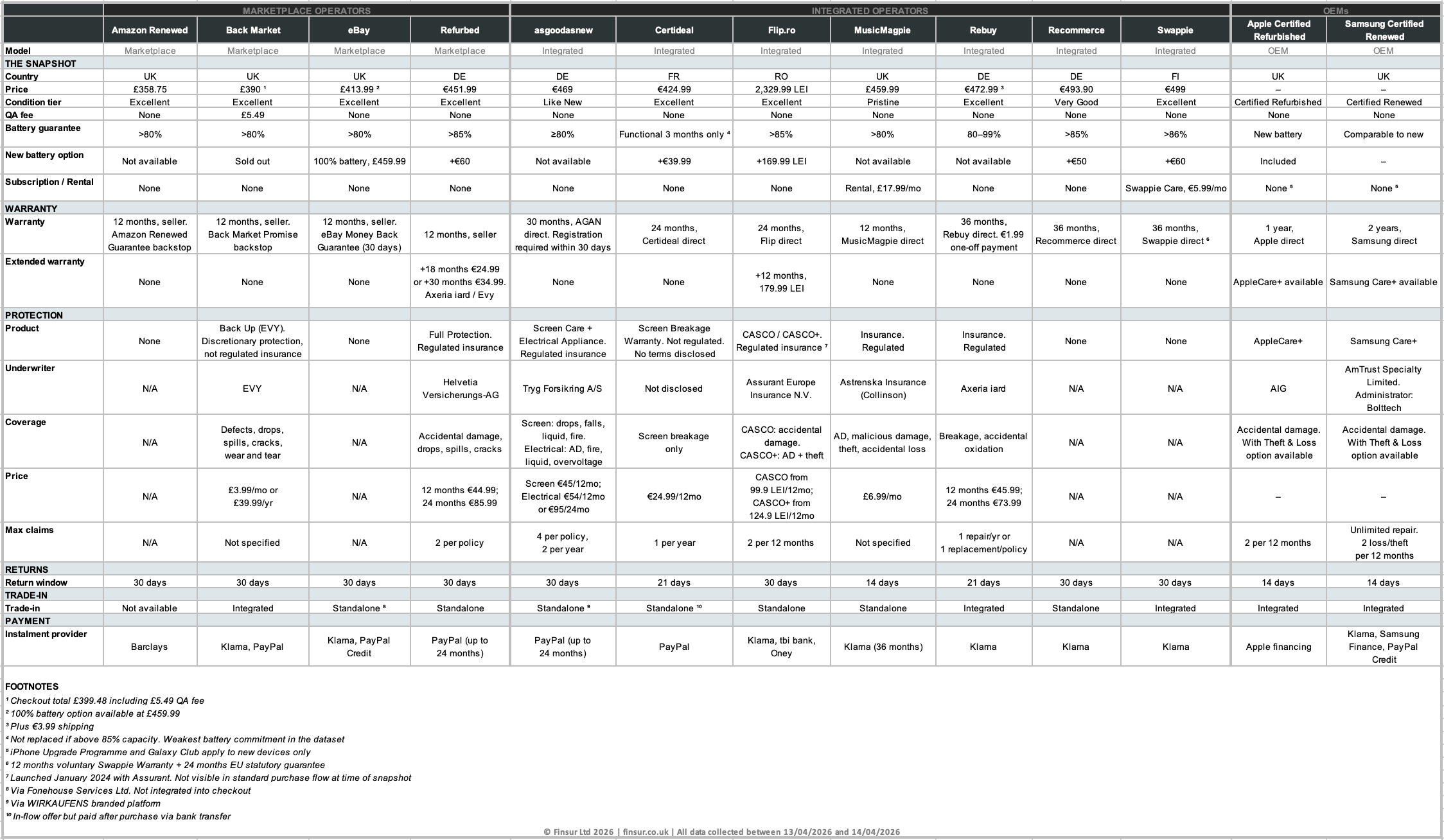
The first point to highlight is that Back Market remain the only operator in the study group to charge a QA fee: £390 headline and £399.48 at the checkout. I know that one or two other operators dotted around the continent do it, but none are at the scale to be included here, yet. For more information on the mechanics of the variable fee that doesn’t really feel like it’s related to quality, check out my pre-Christmas purchase experience here.
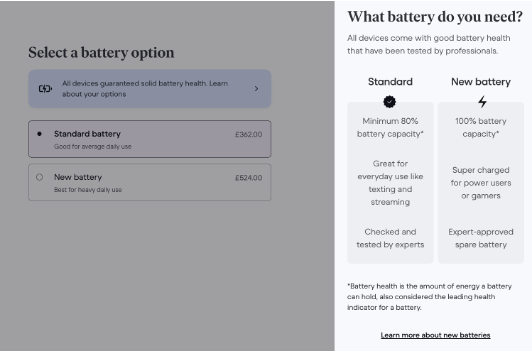
Anecdotally, we know that consumer concerns about battery health play a large role in overall quality considerations so it’s good to see operators beginning to compete beyond the 80% minimum. Still at the floor, Amazon, Back Market, asgoodasnew (AGAN), MusicMagpie and Rebuy have an 80% minimum, although Rebuy actually states explicitly an 80-99% range. Three operators: Refurbed, Flip.ro and Recommerce sit at >85% and Swappie nudges the commitment further with a >86% floor. At the top, OEMs set the benchmark with Apple’s brand new battery in a certified device and Samsung’s odd “comparable to new” approach. Admittedly, my OEM grade comparison is a little off here: Back Market’s Premium grade advertises a 90% battery guarantee, although that commitment only lasts for the first 30 days only. From month two onwards the threshold drops down to the more usual 80% limit, making it a 30-day proposition. An Apple out-of-warranty battery replacement costs £99. For a buyer weighing Back Market Premium against Apple Certified, that £99 erodes most or all of the headline price saving, given Apple includes a new battery as standard.
A new battery was available, as a premium option, from six operators during the investigation. eBay (seller-dependent), Refurbed, Certideal, Flip.ro, Recommerce and Swappie all provided the option for a new battery. Back Market listed the option, but it was sold out for the reference device. Four operators did not have the option available: Amazon, AGAN, MusicMagpie and Rebuy.
Warranty
The approach to warranty provision splits cleanly along operator business model lines. The four marketplace operators sit at the 12-month baseline and rely, as you’d expect, on seller warranties with a platform backstop mechanism. Amazon’s Renewed Guarantee offers a replacement or refund if the product is faulty. Back Market’s Promise acts as an enforcement layer if the seller fails to perform. Refurbed register the claim, coordinate with the seller, and the seller provides a prepaid return label with repair, replacement or refund as the remedy. eBay’s approach felt like a lighter touch with the warranty terms only being available via seller communication post-purchase.
At the other end of the possible options, three of the integrated operators (Rebuy, Recommerce, Swappie) offer a full 36 month warranty, clearly confident in their own repair and refurbishment practices and addressing consumer quality concerns head on. AGAN offers 30 months, Certideal and Flip.ro 24 months and bringing up the rear, MusicMagpie commits only to a 12 month warranty on top of the UK consumer’s statutory rights. Each of the integrated operators warrant directly, with the liability sitting on their own balance sheets but it’s unlikely the provision will ever get large enough to be called out in an accounting note.
Swappie is the most transparent operator in the dataset on warranty structure. Their offer is a clear combination of a 12 month voluntary warranty from date of purchase plus the consumer’s separate legal guarantee, with the total duration varying by market. Not every Swappie customer receives 36 months; in markets where the statutory guarantee is shorter, so is the total. Rebuy is equally transparent, explicitly stating that their 36 month guarantee sits on top of the consumer’s statutory rights and does not restrict them. The remaining integrated operators state a headline warranty period without clarifying whether it incorporates or sits above the statutory floor, which makes direct comparison across jurisdictions difficult. Given the statutory warranty position for used goods varies across EU member states, with Germany permitting reduction to 12 months whilst other jurisdictions may apply the full 24 month consumer guarantee, headline months alone are not the measure of commercial commitment they first appear.

Rebuy’s pricing is interesting. At a €1.99 fixed rate for 36 months, it’s the only paid for option in the study, although cheap at less than 6 cents per month. That probably helps it function as a near-zero friction checkout add-on that’s designed to attach at as near to 100% as possible. It would be great to experiment with some price elasticity over the course of a year. Only an integrated operator that controls the refurbishment quality can price a warranty like that because the expected claim cost is a function of their own operational process.
AGAN’s 30 month warranty requires registration within 30 days of purchase, exclusively via their website. Miss the window and your coverage flies out of it. Even if a third party is involved, making a warranty conditional is archaic. All the necessary buyer data is stored as part of the purchase transaction. For context, Apple warrants for 1 year and Samsung for 2 years, both manufacturer-direct with no intermediation. Apple has previous on the statutory question, having been challenged by EU regulators for promoting its 1 year warranty without adequately disclosing buyers’ statutory rights2.
Protection
Beyond the warranty provision, a number of the operators have stepped into the regulated world of device insurance. Historically, distributors have always held the commercial advantage when negotiating with insurance companies who lap up the volume promises in order to offer the keenest commissions and profit shares in return. Two or three years later, after the volume didn’t arrive and the losses mounted, the distributor goes out to RFP again and the cycle repeats, usually with a new insurer.
Amazon, eBay, Swappie and Recommerce appear to avoid the circus by offering nothing at all on refurbished items. AGAN offer a screen protection or a wider device protection product (electrical appliance) in partnership with Tryg Forsikring. Flip.ro announced a partnership with Assurant including accidental damage and accidental damage with theft policies. However, I was unable to find this in the checkout flow during investigation. MusicMagpie use Astrenska Insurance (part of the Collinson Group) and extend the offer to malicious damage, theft and accidental loss. Rebuy partner with Axeria IARD with a narrow coverage for breakage and Refurbed use Helvetia Versicherungs-AG with a standard accidental damage cover.
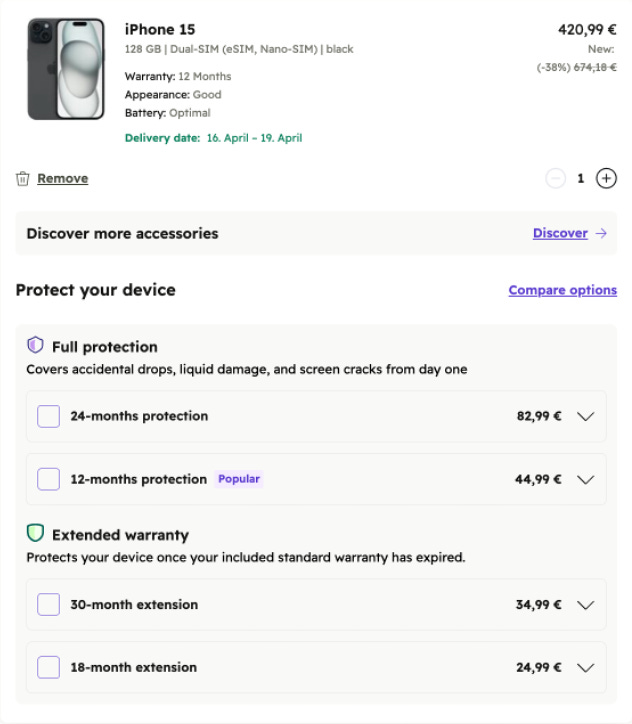
Certideal’s Screen Breakage warranty sits in a different position. No underwriter was disclosed, or terms made available at the point of sale, or regulatory documentation easily identifiable at the point of sale. Whether this is due to the status of the product as a warranty, and believed to be outside of compliance scope was unclear.
Back in September 2024, I’d reported that Back Market distributed an insurance product via some combination of Wakam, Cardif and Bolttech which had subsequently moved on to the Watford Insurance Company3 . Sound familiar? Well things have moved on again. On the face of it, their “Back Up” product to the casual observer is described in terms similar to the usual protection policy. To anyone with an unhealthy interest in words, however, the difference between “unlimited repairs” and “unlimited repair requests” becomes clear when the product wordings state “This Service is not an insurance product and does not operate as one. It is a discretionary protection service, provided and administered at Our sole discretion.”
Anyone with history in the protection space will observe that if it looks like insurance and smells like insurance, any European regulator might pointedly suggest that, it’s insurance. Ask tenured D&G employees who spent the best part of 5 years capitalising their way out of discretionary service products towards insurance4. Still, I’m likely over-analysing, things may have moved-on and the book is unlikely to hit regulators’ risk radar in the same way D&G did. However, if you’re thinking about adding a protection product, there are plenty of experienced underwriters and administrators, big and small, who create insurance programmes sans-discretion.
Trade-In
A few years back, most trade-in processes operated via a separate website. The buying and selling transactions were entirely distinct. By this time last year, things had evolved with inline hand offs to co-branded or partner sites that would deal with the device buy back transaction. That approach is now looking dated as well. Clearly there’s need for a separate process to simply sell a device, but for consumers looking to upgrade, having the trade-in option integrated into the check-out flow has quickly become the default.
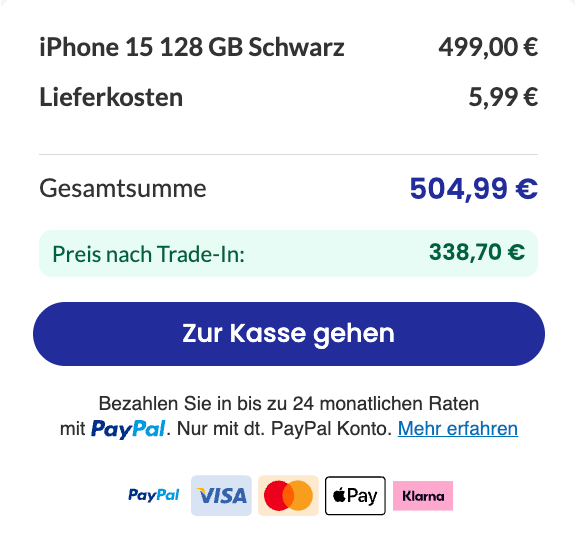
Apple and Samsung moved to this approach in the back-half of last year and four of the operators followed suit. Back Market, Rebuy, Swappie and Certideal all operate neat consumer journeys that either discount the trade-in value from the basket total, or refund the trade-in value immediately post sales transaction.
Five operators offer a standalone trade-in process only, separate from the purchase flow: eBay via the increasingly present Fonehouse Services group in the UK, Refurbed, AGAN via their WIRKAUFENS branded platform, Flip.ro and Recommerce. MusicMagpie present buying and selling as equal and separate propositions, directing consumers to the appropriate site accordingly. For a business whose core model depends on acquiring devices, the absence of an integrated trade-in flow is a missed opportunity and, post AO integration, one that’s surely high on the IT priority queue.
Beyond the Transaction
There are a few items of differentiating interest beyond the buying and selling processes. Swappie Care at €5.99 per month looks like the only upgrade subscription model in the dataset. It provides the consumer with a 90% discount code for a maximum of two upgrades in a 12 month period, transferring to the new device with a maximum of 5 years, I assume as a residual value protection mechanism.
MusicMagpie have been running a rental model alongside their sales for a number of years now and despite a capital intensity blip a few years ago, the offer looks firmly settled with the new bank of mum and dad’s backing.
In another attempt to address the quality question, Recommerce have opted for a certification. The RecQ label is a European quality mark for refurbished products (phones, PCs, tyres, etc.) that involves an audit of the whole chain from sourcing through testing, data wipe, repair and resale against a detailed set of criteria beyond basic regulatory compliance. It was designed and is governed by RCube, the French reuse federation, which manages the standard and label committee, while DEKRA acts as the independent certification body performing on‑site audits and grants or renews the label for three‑year periods with annual surveillance. Recommerce has obtained this “RecQ – Reconditionnement de Qualité” label, so its refurbishment processes are assessed under this RCube-owned scheme and then verified by DEKRA.
What’s Next?
Insurance is perhaps the most underdeveloped service offer across the group and this, at least in the UK, will have contributed to a significant YoY decline in attachment rates on refurbished devices in 20255. Amazon’s continued and increasing presence in device sales, new and refurbished6, without an insurance offer is the largest gap, but other operators should be working with insurance programme managers to offer at least an accidental damage cover at the checkout. I’m not in favour of advertising multi-use benefits (e.g. unlimited repairs) if they are not used, I’d prefer to see single claims and lower prices, matching the discounted price that refurbished buyers are in the market for.
Whilst it’s great to see the directional shift away from the 80% battery floor guarantee, more work needs to be done to increase it. If the manufacturers continue to suggest <80% is suboptimal, products delivered close to this are going to continue chipping away at consumer confidence. Now, my own refurbished iPhone happily operates all day below the 80% mark, but then the perception needs to be addressed as well as the technical boundary.
Flexible payment options are ubiquitous across the operators, but the further shift towards a rental option is not. Clearly the intense pressure on working capital over the rental and renewal cycle is preventative in a sector already struggling with margins. However, third-party providers are worth exploring to deliver an alternative ownership option for the consumer segment that looks beyond price. It’s hard to get a handle on popularity of the OEM subscription products, and at the time of writing they were not available on refurbished devices. Clearly, this is where the sector has an advantage and with product support extending, the all important second rental period for a refurbished device is well within operational reach.
Quality certifications may help with credibility, but from a consumer perspective risk becoming just as meaningless as grade labels are currently without significant public explanation. Recommerce’s efforts are to be applauded, but the RecQ / DEKRA certification route was something that required further research which is unlikely to impact the buying decision for price conscious customers when free 30-day return periods backstop the risk anyway. More thought required.
As the points of differentiation standardise, it would be great to see forward trade-in assist devices into their third lifecycle or parametric type insurance offers supporting a battery replacement in the event of degradation below the 80% floor. Perhaps policies that automatically add loss and theft during international travel could bridge the binary approach that’s defined the market to date. Maybe a trade-in credit balance on the consumers account could help pull those dormant drawer phones back into the ecosystem, even if a few € or £ for the older devices could help people save towards their next refurbished device?
This article maps the current service propositions across the main European CE recommerce operators and suggests a few near term options for further investigation. The question it raises is which of these eleven has the financial foundations to sustain and develop those offers over time. For that you’ll need to check out the European CE Recommerce sector report if you’ve not already…
Peace,
sb.
Methodology
Service proposition data was collected via direct purchase journey walkthrough for each operator, using an iPhone 15 128GB as the reference device (except Samsung), between 13 and 14 April 2026. Price data was recorded for context only; different countries, currencies and VAT treatments make direct price comparison misleading and it is not the purpose of the article. Insurance regulatory status was assessed from product documentation available at the point of sale; where no IPID or underwriter disclosure was present, the product is described accordingly, and regulatory classification is as presented by the operator without independent legal assessment. Warranty durations are recorded as stated by the operator; statutory warranty floors vary by EU member state and are not factored into headline figures unless the operator disclosed them explicitly. OEM data was collected from Apple and Samsung UK storefronts on the same dates. All data reflects the position at the time of collection and operator propositions are subject to change without notice.