

If I’d approached the CCS Predictions series numerically, as originally intended, this article would have been second not the last. But when I sat down and started thinking about what was being suggested, I changed tack. The better scenario narrative developed along the lines of: manufacturers take control (Prediction 36), integrate buy-back into their business model (Prediction 62), keep devices regional (Prediction 60), and the cumulative effect is organised secondary markets reaching scale globally. Prediction 59 states that “By 2029, the organized secondary market accounts for 40% of second-hand device sales globally”.
The rationale is: “CCS Insight research identifies the organized secondary market as retail chains and other large-scale companies processing high volumes of second-hand smartphones, smartwatches, tablets and laptops. The entry of new players, expansion by established brands and rising awareness of the environmental impact of device manufacturing see this market continue its upward trajectory. The trend is also helped by manufacturer buy back schemes and similar initiatives”. Hard to disagree with, but much harder to quantify.
1. The Measurement Problem
CCS Insight data showed 108.4m unit sales in the global organised secondary market (GOSM) in 2024 valued at $32bn and forecast to reach $46bn by 20281. Their 2025 forecast predicts sales will rise by 5.44% in 2025 with significant regional variation in growth rates. The Middle East & Africa lead the way with Europe at the other end of the scale, almost flat2. CCS also identify that 60% of sales in the GOSM are iOS and 40% Android. The point is, despite some occasional opacity, it’s easier to get information from things that are organised.
On the other hand, the unorganised secondary market is full of hand-me-downs and hand-me-overs between family members, WhatsApp deals between mates, market sales and ma’ & pa’ repair shop shenanigans, all of which is a bit foggy and certainly doesn’t appear in any dataset. Hitting the 40% target would require getting information from things that are unorganised.
The shortcut is to work top-down. Discarding the outliers, there’s current consensus around a total global secondary market of 300m to 315m units annually which gives us a denominator for the 40% calculation: 108m organised / 310m total = 35% of devices currently flow through the GOSM3. CCS predicting 40% by 2029 would therefore imply modest growth, perhaps 5 percentage points over 5 years. But, shift the denominator assumption by 20-30m units either way and the current share moves between 31% and 38%. Reasonable changes create meaningful swings in the output.
So, rather than faff about trying to get a handle on 20m here or 30m there, the more interesting question is: where does the growth in the organised market come from? The GOSM is already well-established in North America and Europe, mature markets with a high organised share. Achieving 40% globally means formalisation would have to accelerate in markets where informal channels persist. That might be a bigger ask than it sounds.
2. The Regional Picture
North America (22.2m units) and Europe (20.4m units) together account for 39% of global GOSM volume. Within these regions, organised channels handle approximately 70% of secondary sales. Formalisation began years ago and these markets are at a different stage of maturity. Apple and Samsung run mature trade-in programmes alongside significant telecoms programmes, especially in the US. Retailers additionally run trade-in programmes, and specialists like Back Market, Swappa, and Refurbed proliferate. North America is a net exporter; Europe is supply-constrained with organised secondary growth forecast below 1% in 20254. The organised markets are very likely close to, or at their ceiling.
APAC might be the swing region. At 52.7m units it contributes nearly half of the total GOSM volume, but the organised share as a percentage of the total trade lags considerably. In India, CCS data confirms 85% of the secondary market remains informal5. Cashify and Yaantra are growing, but off a relatively low base. China’s secondary market now accounts for 20% of its total smartphone sales6, significant activity, but the organised/informal split within that isn’t well documented. Regardless, Huaqiangbei is very likely to remain the supply engine for informal trade, and WeChat P2P is firmly established as the only payment method you need. Organised players like Aihuishou and Zhuanzhuan are scaling, but how much of the market they’ve captured is unclear. This is where the 40% target gets won or lost.
Latin America (5.0m units) and MEA (8.1m units) together represent 12% of GOSM volume. Both are net importers with approximately 35-40% of devices sourced externally. Both show the fastest growth rates globally, with MEA leading7. But this is early-stage formalisation off a small base. Mercado Libre dominates LatAm; Jumia and Revibe are building in MEA. The organised share within these regions is estimated at 20-25%, and the rest flows through street markets, repair shops, and mobile money P2P.
With mature markets near their ceiling, mathematically reaching 40% globally requires emerging markets to shift from roughly 25% organised toward 35% plus. That’s not a small ask. It assumes formalisation is inevitable, that organised channels will steadily absorb share from informal. But in markets where the corner shop already works well, what would actually drive that shift?
3. The Formalisation Question
Naturally my lens is on the organised side of the market, I am not claiming any expertise on informal markets, but in researching this article, a consistent picture emerged: informal channels are not broken systems waiting to be fixed by western style formalisation; they work perfectly well in their context. The shift from unorganised to organised only happens when someone builds a value proposition that beats the local alternative: better choice, higher quality, long warranties and so on.
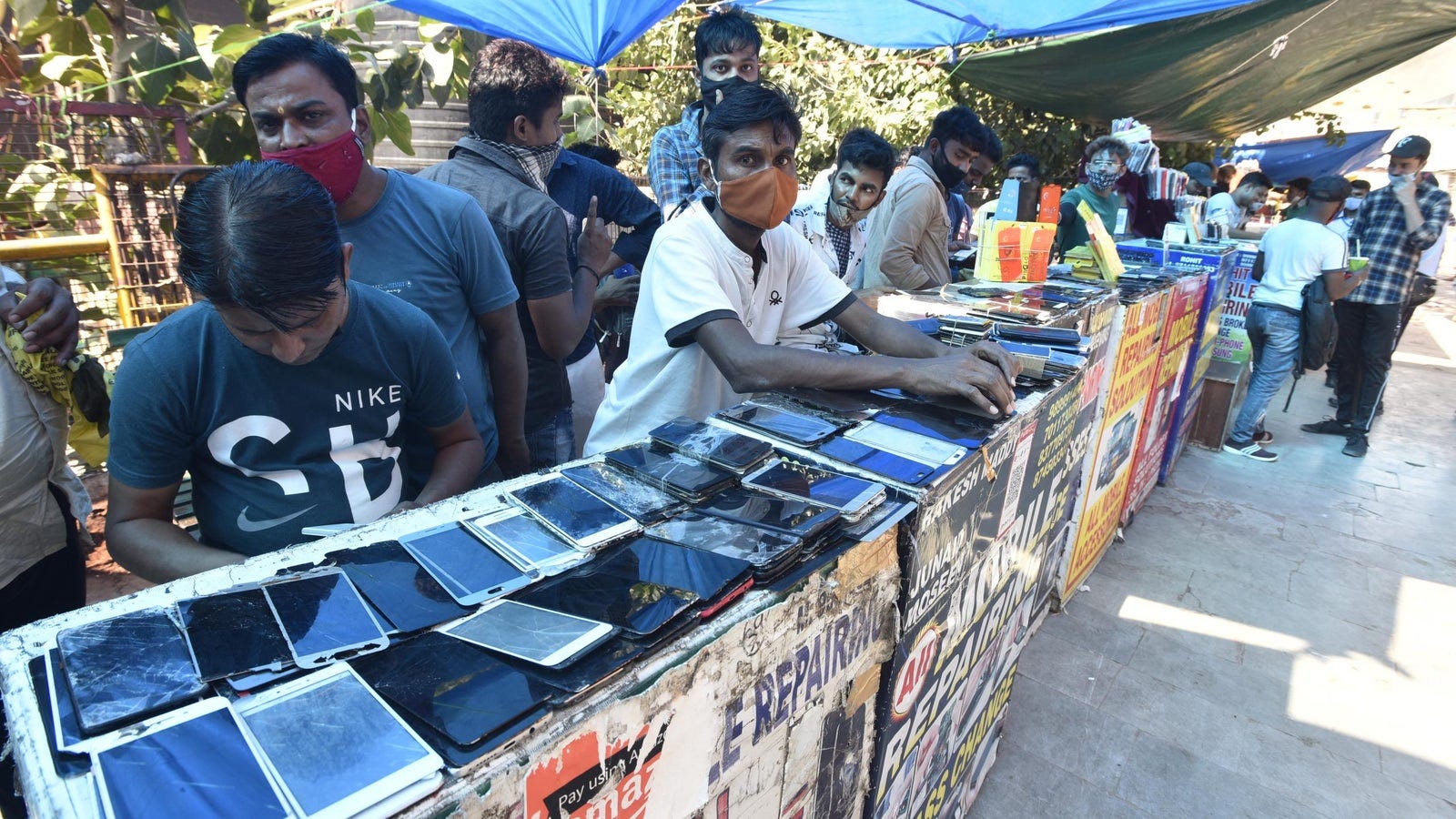
The likes of Gaffar Market in Delhi, Huaqiangbei8 in Shenzhen and Computer Village9 in Lagos are dense, functional trading hubs that have operated successfully for decades. Trust is established through credibility over time, through repeat interactions with a neighbourhood shop that can repair, unlock and service after sale. Personal trust outweighs the generic, distant marketing message or warranty promise of an online platform. The seller is the after-sales service: buy a phone, get it fixed later at the same shop.
Organised channels rarely match this simplicity. Warranties and insurance involve shipping, waiting, and occasional wrangling with call centres. Transactions happen without KYC, bank accounts or formal credit. In Africa, M-Pesa and MTN Mobile Money are the rails10, with mobile money agents and phone sellers often overlapping and in countries where a smartphone could be 25% of monthly GDP per capita11, trusted and cheap wins.
So what could shift the balance? And what might hold it back? If ASPs rise, BNPL and trade-in credit might become more attractive, particularly for aspirational purchases like the iPhone and flagship Galaxy models. Financing requires more organised infrastructure with credit checks, possibly device tracking and certainly recovery mechanisms. Unorganised channels rarely offer “pay in 3, 6, 12 or 24 month instalments, so if financing scales, the organised market may develop an edge.
A $400 iPhone is a far bigger bet than an $80 Android and as consumers move up the price points the cost of a dud increases alongside the willingness to pay for greater assurance. Third-party refurbishers like Cashify and Grest already offer warranties and grading in India. OEMs have been slower to move: Apple’s 2016 attempt to import certified refurbished iPhones was blocked by India’s anti-dumping rules12. But with Apple now the fifth-largest smartphone brand in India by volume13, the refurbished supply will emerge naturally and volumes will be material. Trade-ins and upgrades from a growing installed base, no imports required.
The first two articles in this series traced how manufacturers may build out their circular flywheels, partly in response to declining new sales in some mature markets using trade-in as an ecosystem acquisition strategy and with certified refurbished devices as margin protection. Apple, Samsung and the popular Chinese manufacturers may skip the wait for markets to mature and begin to apply marketing budgets and infrastructure that the unorganised sector can’t match.
Transsion, the Chinese manufacturer behind Tecno, Infinix and Itel (dominant brands across Africa) already offers a clue. Its after-sales arm, Carlcare, thrives by tapping into the informal repair shop networks rather than competing against them14. Decentralised, localised and blending formal quality assurance with informal convenience. If the organised secondary market is going to win share in these regions, that hybrid approach offers an interesting template.

But there are counter-forces. Informal is already efficient. Huaqiangbei can source, refurbish and ship faster than most platforms. Gaffar Market offers same-day repair and resell. Computer Village has served Lagos for decades. They are not gaps waiting to be filled, they are the entrenched competition. Affordability constraints are structural, not transitional: price beats warranty for many consumers, and if organised channels carry cost premiums through grading, certification and platform fees, informal remains attractive. Relational trust does not scale easily and bundled repair (”buy here, fix here later”) requires a retail footprint many organised players do not have.
So where does that leave the 40% target? Organised channels will have to earn their place by offering something better than the corner shop. In North America and Europe, they did. Warranties, platform convenience, sustainability messaging and financing won consumers over. In APAC, LatAm and MEA, the outcome is less certain. Formalisation is not inevitable; it is a value proposition challenge. CCS may well be right and that we reach 40% by 2029, but the prediction assumes organised wins in markets where informal already works well. It’s not impossible, but it is not guaranteed either.
4. What to Watch
Given the measurement challenge, we might be better watching for supplementary indicators to help determine whether 40% is on track.
OEM behaviour matters. Do Apple and Samsung expand certified refurb and trade-in aggressively in India, LatAm and Africa, or do they stay focused on mature markets where the infrastructure already exists? The first two articles in this series traced their strategies in Western markets. Whether they apply the same playbook to emerging markets, with the marketing budgets and retail presence that entails, will shape how quickly organised channels grow.
Financing penetration is another signal. BNPL and device financing adoption in price-sensitive markets could tip the balance. Informal channels cannot easily offer instalment payments. If financing scales, organised develops an edge that is hard to replicate, especially for premium devices.
Platform investment is worth tracking. Are Cashify, Aihuishou, Mercado Libre and Jumia scaling, raising capital and expanding footprint? Watch for acquisitions, particularly organised players buying into informal infrastructure (the Carlcare model). That would signal a hybrid approach gaining traction.
The clearest signal that 40% is happening would be organised share in India moving from 15% toward 25% or higher, and China’s organised players capturing a measurably larger slice of their secondary market. If those two don’t shift meaningfully, 40% globally becomes arithmetically difficult.
5. Closing it Out
This series traced a single thread: the industrialisation of device lifecycles. Manufacturers taking control of trade-in and resale in mature markets (Prediction 36). Buy-back offers integrated into product launches (Prediction 62). Devices staying regional as circular economies form (Prediction 60). And now the question of whether that model scales globally (Prediction 59). The flywheel is spinning in the West. Whether it catches elsewhere remains to be seen. Directionally, CCS is probably right. Organised is growing, the trends are supportive, and investment is flowing into the sector. But precisely right? That depends on whether a warranty and an app can beat a handshake and a soldering iron.
Peace,
sb.
CCS Insight data provided directly
IDC estimated global secondary smartphone shipments at 309.4 million units in 2023 (https://www.businesswire.com/news/home/20240122277827/en/Worldwide-Market-for-Used-Smartphones-Is-Forecast-to-Surpass-430-Million-Units-by-2027-According-to-IDC); Mordor Intelligence forecasts 315 million units for 2025 (https://www.mordorintelligence.com/industry-reports/used-and-refurbished-smartphone-market).
CCS Insight data provided directly; organised share estimates derived from regional benchmarks
Ibid.
CCS Insight data provided directly
McKinsey: “The Future of Payments in Africa” — https://www.mckinsey.com/industries/financial-services/our-insights/the-future-of-payments-in-africa
Atlantic Council: “Capturing the African Consumer Market” — https://www.atlanticcouncil.org/in-depth-research-reports/issue-brief/capturing-the-african-consumer-market-2/
Thanks for sharing Stuart, share many of your sentiments. Especially agree with you on part 3, it is not as easy to label certain markets and channels as "organized/informal/etc".
For new-device shipment tracking, sales channels can be clearly identified using OEM-defined sales structures. OEMs segment their sales organisations by channel (e.g. telco, open market/distributors, chain stores), with each channel typically operating under separate revenue recognition and P&L, supported by distinct sold-to codes. For example, UK telco Three would have its own sold-to code under an OEM’s telco division, while Tesco would be classified separately under a chain store or hypermarket category.
The same kind of clarity and visibility does not exist for the used phone market simply because the supply and value chain is so different. Firstly the supply can come from various sources; trade-in, bulk purchase, cross-selling among dealers (organized and unorganized), etc. Warranty is also usually guranteed by seller not OEM (unless certified refurbished program maybe)?
There are some accounts on Carousell (marketplace app in Singapore) with over 10K reviews and a very organized operations with runners across the city to pick up your phone within an hour. Not sure whether they fall under "organized" or "unorganized". We probably need a more fluid or robust way to define the sales channels for the used phone market than the one for new phones just due to the different nature of the supply and value chain.